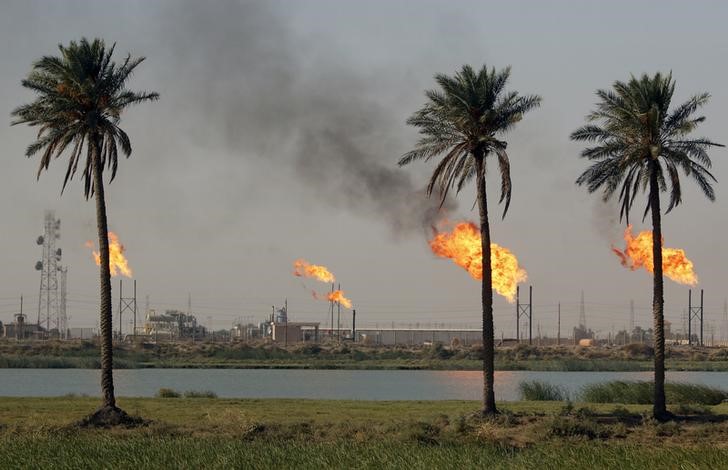
Iraq's oil production has collapsed roughly 60% to about 1.7–1.8 mb/d from ~4.3 mb/d as the Iran war and tanker shortages effectively shut the Strait of Hormuz, a route handling ~20% of global oil exports. UAE and Kuwait have followed with cuts, storage capacity is filling and export routes are constrained, creating acute supply risk and market volatility that has cooled a prior ~30% oil rally amid G7 emergency reserve talks.
The immediate market transmission is not just a supply gap but a logistics shock: constrained tanker availability blows out regional storage demand and steepens physical contango, concentrating price pain in time-spread volatility and charter markets rather than a linear spot-price jump. That creates profitable frictions — owners of spare storage and available tonnage capture convexity in a way upstream producers cannot, and trading houses that control storage capacity will earn optionality-like returns if the disruption persists beyond 4–12 weeks.
Second-order winners are Atlantic-basin producers, US Gulf export infrastructure and storage owners, and listed tanker owners; second-order losers include insurers, Gulf fiscal balances, and refiners without access to alternate crude streams who will see feedstock premium and margin pressure. Expect cracks to bifurcate regionally: refiners with flexible crude slates (USGC, Brazil) gain at the expense of Asia/Mediterranean refiners, and freight-rate inflation will transmit into refined-product delivered costs within 2–8 weeks.
Key catalysts and horizons: days–weeks — insurance directives, convoying decisions and charter reallocation; weeks–months — SPR releases or coordinated G7 reserve actions, quick diplomatic/operational fixes (re-flagging, escorted transits) that can deflate rents; months — shale response and OPEC coordination that determine how structural the new price floor is. The consensus is underestimating mean reversion risk: much of the upside is time-limited and concentrated in convoys/charter dynamics rather than permanent lost barrels, making short-dated convex option structures superior to outright long-duration directional exposure.
AI-powered research, real-time alerts, and portfolio analytics for institutional investors.
Overall Sentiment
strongly negative
Sentiment Score
-0.65
