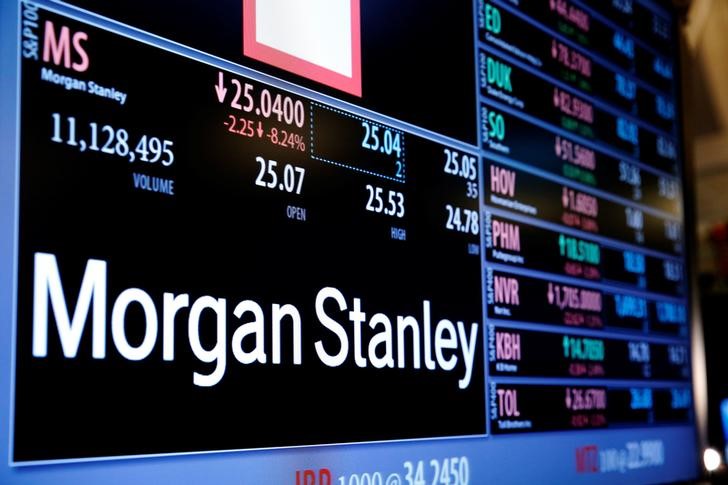
Morgan Stanley drew a reaffirmed Market Perform from Citizens, with the analyst citing improved positioning after recent results and stronger customer engagement across trading, investment banking, and Global Wealth Management. The company also reported record Q1 2026 EPS of $3.43, beating the $3.02 estimate by 13.6%, and revenue of $20.58B versus $19.7B expected. Management signaled AI initiatives in wealth are expanding beyond efficiency to productivity gains, while defending the long-term private credit opportunity despite recent scrutiny.
Morgan Stanley’s setup is less about a one-quarter beat and more about the market re-rating the durability of fee generation. The mix matters: strength in wealth and advisory lowers dependence on purely cyclical trading, which should compress perceived earnings volatility and support a higher multiple if management can prove operating leverage persists. That is especially relevant in a market that has been paying up for “capital-light, recurring” financials versus more balance-sheet-intensive peers.
The AI narrative is potentially the most important second-order catalyst. If embedded into the advisor workflow and back office, it can raise revenue per advisor and reduce cost-to-serve without requiring headline branch or headcount cuts, which means the upside can show up gradually in margin expansion rather than a flashy one-time cost reset. That tends to be underappreciated by analysts because the benefit compounds over several quarters and is easier to miss in near-term guidance.
Private credit is the more obvious overhang, but the risk is likely being overstated in the short run and understated in the medium run. Near term, the asset class can absorb scrutiny because realized losses typically lag the macro by quarters; the real pressure point is if credit spreads widen into a slower-growth backdrop, forcing marks and fee pressure at the same time. The market may be missing that Morgan Stanley’s franchise benefits from the narrative of resilience, but its valuation still depends on avoiding a late-cycle credit event that would hit both capital markets activity and alternative asset confidence.
The contrarian take is that the stock may not be a bargain so much as a cleaner earnings compounder than many assumed. If investor expectations shift from “cycle-sensitive bank” to “wealth + alternatives + platform monetization,” multiple expansion could continue even without explosive EPS revisions. But if rates fall fast and capital markets activity cools, the recent optimism could fade quickly because the incremental upside from AI and private credit is more gradual than traders expect.
AI-powered research, real-time alerts, and portfolio analytics for institutional investors.
Request DemoOverall Sentiment
mildly positive
Sentiment Score
0.45
Ticker Sentiment
