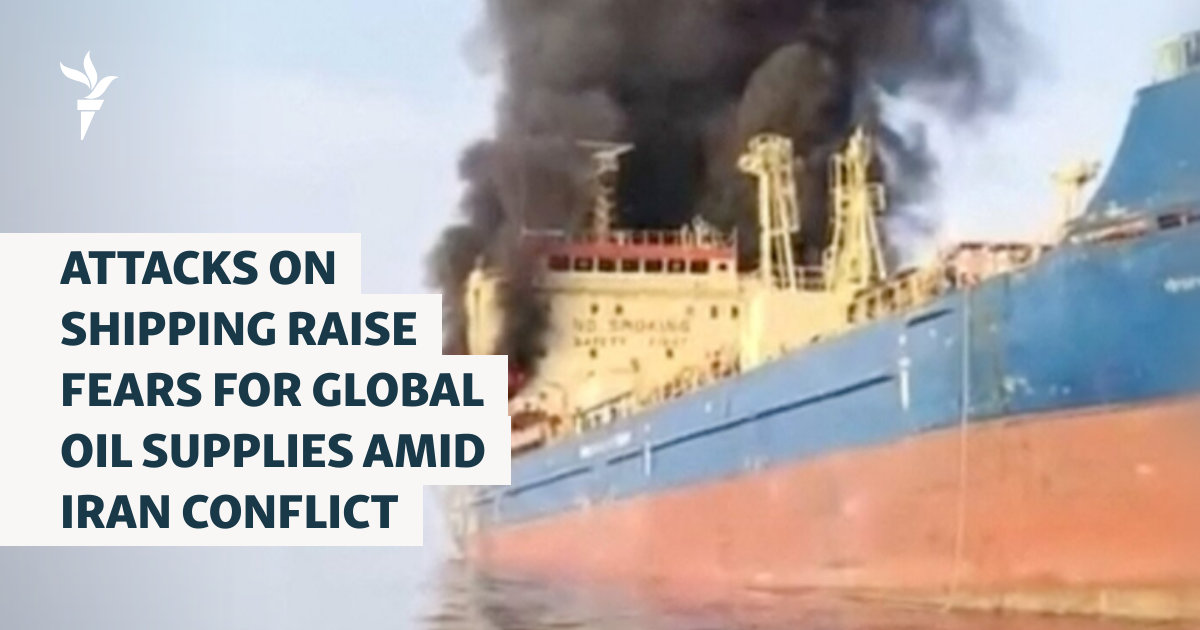
An apparent attack in the Strait of Hormuz on March 1 set fire to the 7,600-ton tanker Skylight and reportedly struck two other civilian vessels while US Central Command said it hit an Iranian corvette, prompting at least 150 ships (including oil and gas tankers) to anchor as insurers and IOCs advised avoiding the route. Global benchmark Brent jumped as much as 10% on the day, while OPEC+ agreed to a modest 206,000 bpd production increase to offset risks; analysts warn prolonged disruption could push prices toward or above $100/bbl and stoke inflationary pressures. The incident amplifies sanctions-related supply reallocation risks (notably flows to China and opportunities for Russia) and highlights constrained alternative export capacity via pipelines, making energy markets and shipping routes a focal point for near-term portfolio risk management.
Market structure: Energy producers with spare export capacity (major integrated oil names and pipeline operators) and LNG shipping/terminal owners are the primary beneficiaries; integrated majors (XOM, CVX) gain cash-flow and pricing power if Brent sustains >$90. Losers include tanker owners on key Hormuz routes, insurers/reinsurers (short-term surge in P&I premiums), and fuel-sensitive sectors (airlines ETF JETS) as input-costs jump. A sustained partial closure (even 1–2 weeks) tightens seaborne flows equivalent to ~10–20 mb/d of crude/lng-transits, shifting power to sellers with alternative pipeline capacity.
Risk assessment: Tail risk — a multi-week full closure would likely drive Brent >$100 within 2–6 weeks and could trigger demand destruction/inflation shock, pushing policy rates up and yields higher; conversely a quick reopening (<7 days) supports a fast mean-reversion. Hidden dependencies include insurance availability, IOC routing decisions, and China’s willingness to reallocate purchases from Iran to Russia/others. Key catalysts: official strait-closure declarations, OPEC+ coordinated output moves, or large Iraqi field shutdowns.
Trade implications: Near-term (days–weeks) favor long energy exposures and volatility plays; medium term (1–3 months) consider directional Brent exposure via Brent futures/ETF call spreads and sector pairs (energy long vs airlines short). Cross-asset: expect headline-driven rise in US breakevens and sovereign yields, potential USD strength on risk-off but commodity FX (AUD, CAD) to outperform if oil spike persists. Use option structures to monetize convexity while protecting downside.
Contrarian angles: The market may overprice a protracted closure—historical parallels (June 2025 12-day spike to ~$80 then fade) show short-lived shock rallies often revert if spare capacity/OPEC+ response is effective. Mispricings will occur on >$100 prints that lack confirming supply disruption (insurance+anchor data); fade rallies that exceed $100 for less than 10 days. Longer disruptions benefit Russian/Chinese bilateral flows despite G7 caps — a structural reallocation risk for Western refiners.
AI-powered research, real-time alerts, and portfolio analytics for institutional investors.
Request TrialOverall Sentiment
moderately negative
Sentiment Score
-0.60
