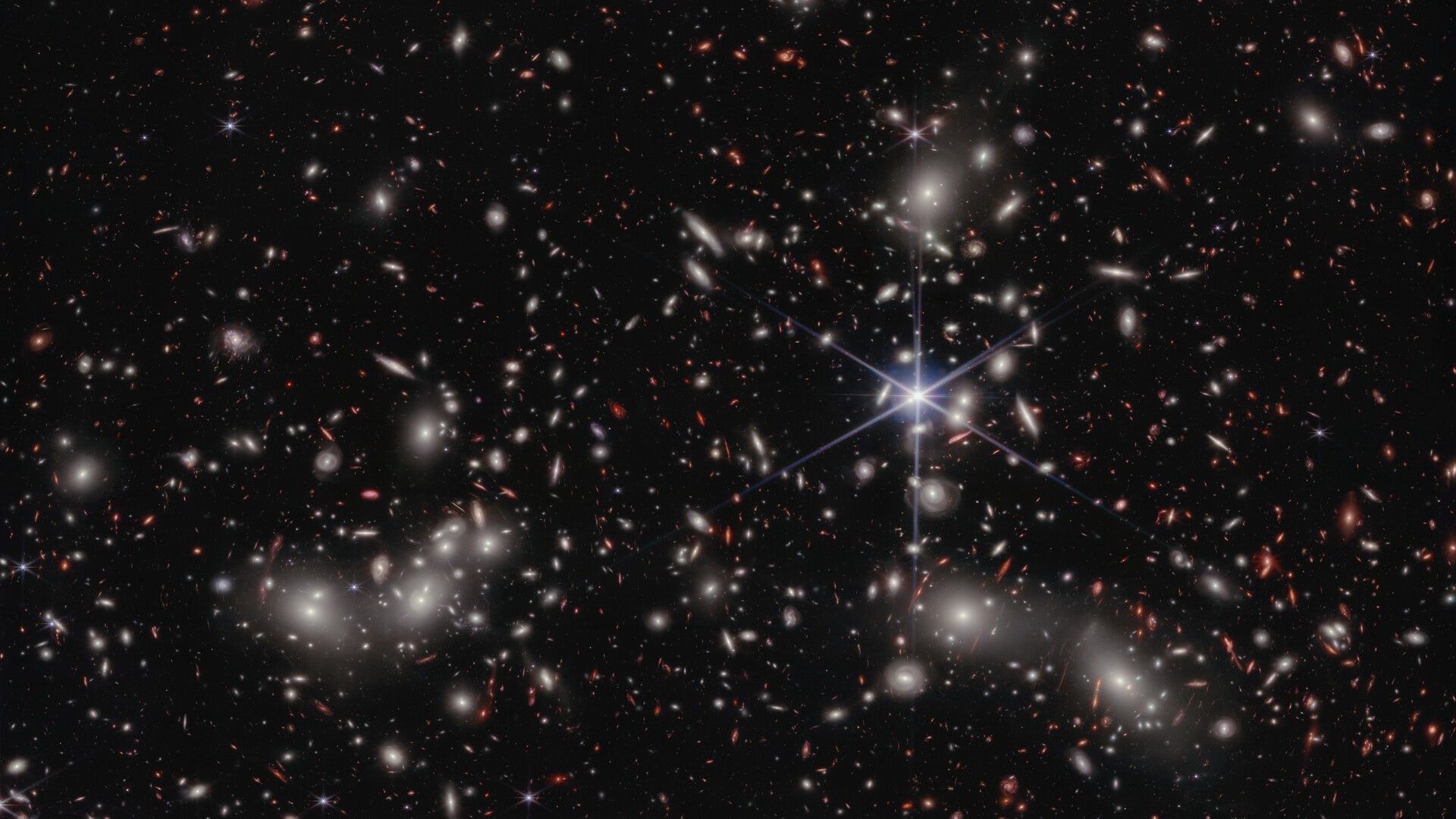
Astronomers directly measured the black hole in Abell2744-QSO1 at around 50 million solar masses, with host-galaxy stars capped at roughly 20 million solar masses. The object appears to be a record-setting 'naked' black hole, suggesting the black hole may have formed before its galaxy fully developed and that standard local-universe mass estimation methods may still apply to little red dots. The findings are scientifically significant for early-universe black hole formation but have limited immediate market impact.
The key market takeaway is not the astronomy headline itself, but that a direct dynamical mass measurement validated a commonly used indirect estimator in an extreme high-redshift regime. That reduces model risk across the broader JWST “little red dot” sample: if the scaling holds, the market for follow-on papers should shift from “are these objects fake/peculiar?” to “how many are genuinely overmassive seeds?”—a subtle but important inflection for the research ecosystem around early-universe structure formation. Second-order, this is bullish for the credibility of JWST-enabled inference pipelines and for the vendors that monetize them. The real beneficiaries are the enabling stack—high-throughput near-IR spectroscopy, adaptive optics, and lensing-assisted follow-up—because the bottleneck is moving from detection to precision characterization. That should support durable demand for premium telescope time, instrumentation upgrades, and data-analysis software/services over the next 12-36 months. The contrarian risk is that investors over-interpret a single spectacular object as regime-wide evidence for exotic seed formation. A sample biased toward strongly lensed, unusually compact systems can make the tail look like the center; if subsequent objects revert toward more ordinary black-hole-to-host ratios, the current excitement fades quickly. The more durable thesis is methodology validation, not proof of primordial or direct-collapse origins. There is no clean public-equity trade tied directly to the science result, so the better expression is thematic and basket-driven. Near term, the catalyst path is additional JWST/ELT follow-up on similar systems; over 6-18 months, each confirmed overmassive seed increases the odds of upgraded forecasts for early SMBH growth and keeps funding/margin support flowing to the scientific-tools complex. The main reversal signal would be a string of null results showing the current object is an outlier created by lensing or selection effects.
AI-powered research, real-time alerts, and portfolio analytics for institutional investors.
Request DemoOverall Sentiment
neutral
Sentiment Score
0.10
