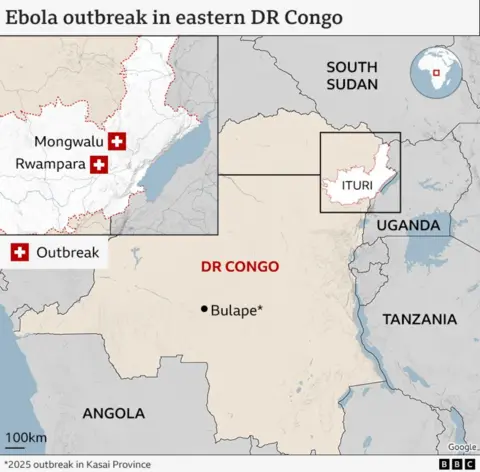
WHO declared the Ebola outbreak in DR Congo's Ituri province a public health emergency of international concern, citing around 246 suspected cases and 80 deaths, with 8 lab-confirmed cases and 2 confirmed cases in Uganda. The Bundibugyo strain currently has no approved drugs or vaccines, and WHO warned of significant uncertainty around the true infection count and geographic spread. The outbreak raises regional spillover risk for neighboring countries and could disrupt mobility, trade, and mining activity in affected areas.
This is less an isolated health headline than a local shock with regional transmission optionality. The market should focus on the probability distribution rather than the base case: if containment works, the macro impact is negligible, but if mobility along the Great Lakes/mining corridor keeps seeding new cases, the risk rapidly shifts from a public-health event to a logistics and border-management problem for East Africa. The biggest second-order effect is on sentiment toward frontier EM risk, where capital tends to price in contagion to travel, consumer activity, and humanitarian response costs long before any actual economic damage is measurable.
The most exposed asset class is not the obvious healthcare basket, but regional risk proxies: East African sovereign and quasi-sovereign credit, airlines, cross-border trucking, and mining-linked transport corridors. Gold-mining towns matter because they imply labor mobility and informal commerce rather than a contained rural outbreak; that raises the odds of ad hoc local restrictions, absenteeism, and temporary disruption in small-cap African miners and service names with concentrated exposure. In global markets, the event is supportive for defensive healthcare tools and diagnostics, but the tradable reaction in large-cap pharma is likely too muted to matter unless a vaccine/treatment procurement cycle emerges.
Catalyst timing is days to weeks for headline risk and 1-3 months for actual spread confirmation. The key reversal would be rapid ring-fencing of cases, transparent tracing, and no meaningful geographic broadening; the key tail risk is cross-border amplification into a larger transport and trade issue, which would force governments into reactive restrictions despite official guidance. Consensus may be overpricing the immediate global macro threat while underpricing the regional credit and logistics spillover, which is where the cleaner risk-adjusted opportunities likely sit.
AI-powered research, real-time alerts, and portfolio analytics for institutional investors.
Request DemoOverall Sentiment
strongly negative
Sentiment Score
-0.72
