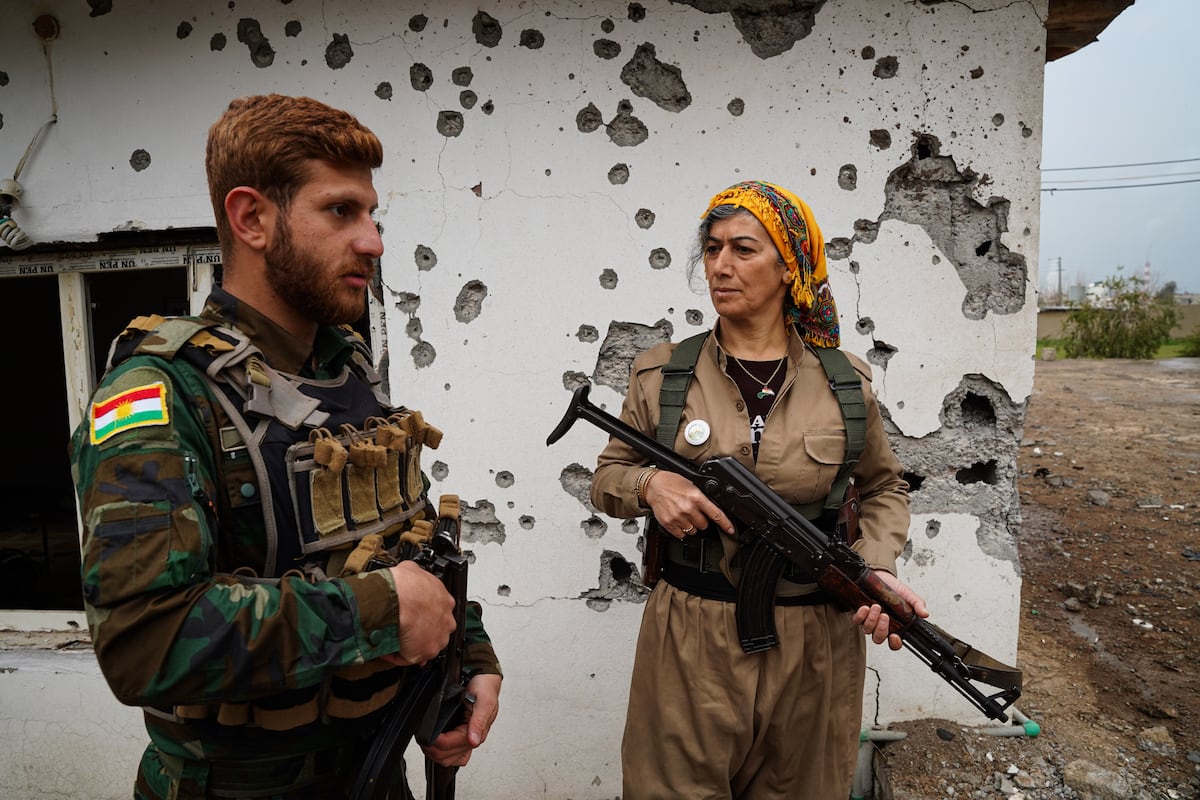
U.S. President Trump has shelved a reported plan to use Iranian-Kurdish militias in an offensive against Tehran; Kurdish groups (~<5,000 fighters) say they will only intervene if the regime shows clear weaknesses. Iran’s regular army and IRGC total over ~600,000 troops; in the first two weeks of the conflict Iran and allied militias launched >300 projectiles into Iraqi Kurdistan, injuring ~40 and killing 7. Iraqi Kurdistan and Turkey oppose use of Kurdish territory, and only light weapons deliveries from the CIA have been reported — raising regional escalation risk and keeping investors risk-off.
The immediate tactical decision to shelve Kurdish ground involvement reduces the probability of an abrupt multi-front escalation, but it materially raises the odds of a prolonged, high-intensity aerial and stand-off campaign focused on border infrastructure and leadership decapitation. That profile favors demand for precision munitions, persistent ISR, and logistics/airlift capacity rather than large-scale ground-systems procurement — meaning revenue upside will concentrate with suppliers of sensors, guided munitions, and sustainment rather than armor makers.
Operationally, the Kurdish strategy to “wait for cracks” creates a time window (weeks-to-months) where limited kinetic pressure can be calibrated to inflict attrition without triggering full mobilization by regional powers; this preserves an asymmetric bargaining chip for exiled Kurdish leaders but also increases tail-risk of episodic cross-border strikes that temporarily disrupt northern energy flows and transit routes. Expect market sensitivity around discrete catalysts (Turkish military posture shifts, KRG base raids, or a U.S. policy reversal) with price moves concentrated in EM FX, regional credit spreads and defense equities.
From a portfolio perspective, this dynamic is convex: near-term downside is capped if no ground surge occurs, but a persistent strike campaign or spillover into KRG territory would produce concentrated upside for ISR/munitions names and safe-haven assets. Key monitorables over the next 30–90 days are Turkish diplomatic signals, KRG security posture, and evidence of increased ISR/missile procurement orders or expedited deliveries — any of which would materially re-rate sector positioning.
AI-powered research, real-time alerts, and portfolio analytics for institutional investors.
Request DemoOverall Sentiment
mildly negative
Sentiment Score
-0.35
