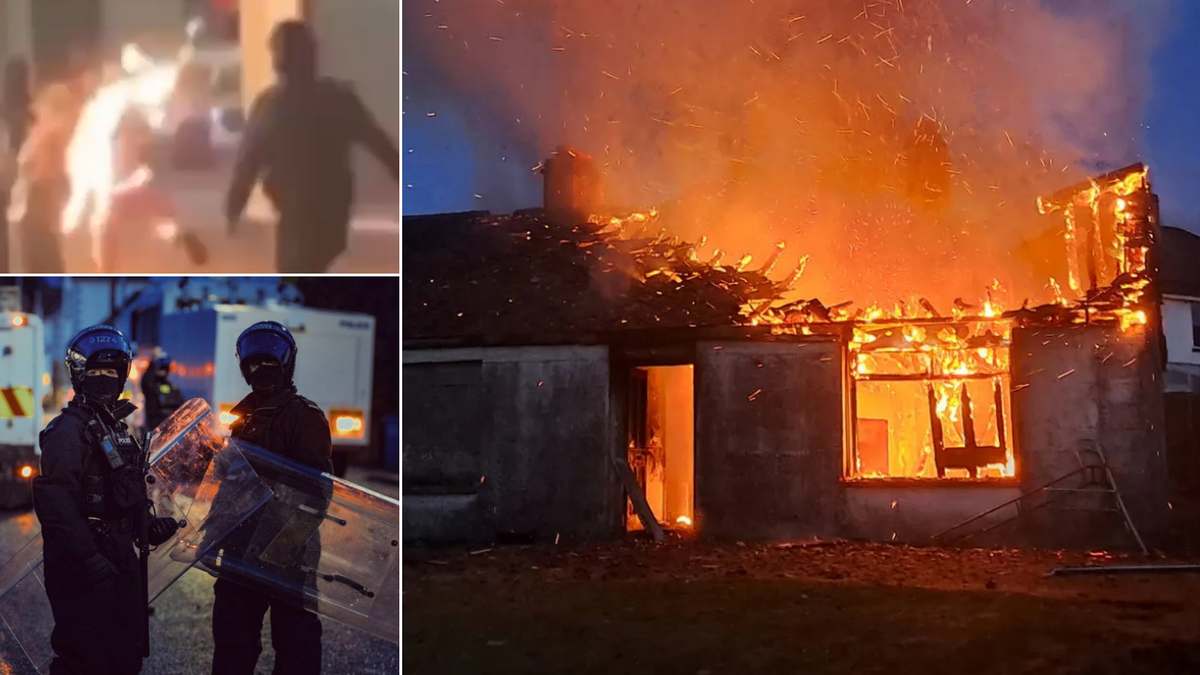
Northern Ireland saw a second night of sustained violence, including a rioter setting himself on fire while attempting to throw a petrol bomb, police deploying dogs and a water cannon, and a DfI lorry being burned in Newtownabbey. Twelve police officers were injured as disorder spread across multiple areas, with transport services suspended and businesses closing early. The unrest and calls for tougher social-media and immigration enforcement raise near-term public order and policy risk in the region.
The market impact is not the headline violence itself; it is the forced re-pricing of Northern Ireland’s near-term operating environment. Even if the disorder cools within days, the second-order effect is a higher friction cost for every business that depends on just-in-time transport, depot access, late-shift labor, or retail footfall in mixed-use corridors. That is a direct hit to local logistics, convenience retail, and discretionary spend, while insurers and security contractors see an immediate uplift in demand and pricing power.
The more important catalyst is whether this remains a contained public-order event or evolves into a rolling security premium. If social media coordination, copycat attacks, or retaliatory incidents persist over the next 1-3 weeks, the trade moves from one-off disruption to a broader confidence shock: delayed hiring, higher private security budgets, earlier store closures, and a temporary drag on municipal and transport activity. That scenario also increases the probability of broader political scrutiny around border policy and online content regulation, which can feed into UK-wide legislative risk assets.
The consensus underestimates how quickly local violence can transmit into operating losses for small-cap regional exposure, even without direct physical damage. The more underappreciated beneficiary is not a defense name but companies monetizing protection: security services, cash handling, and certain insurers with regional commercial books. Conversely, transport and consumer-facing businesses with heavy Northern Ireland revenue concentration can see margin compression from lost trading hours and higher incident-driven operating costs before any earnings revisions show up.
Contrarianly, the event may fade faster than the rhetoric suggests if police containment holds and political leaders successfully separate immigration policy from street disorder. In that case, the best shorting opportunity is in over-hedged fear trades rather than the underlying economy. The key is duration: a 48-72 hour stabilization would argue for fading panic, while a second weekend of mobilization would justify a more durable risk-off positioning.
AI-powered research, real-time alerts, and portfolio analytics for institutional investors.
Request DemoOverall Sentiment
strongly negative
Sentiment Score
-0.78
