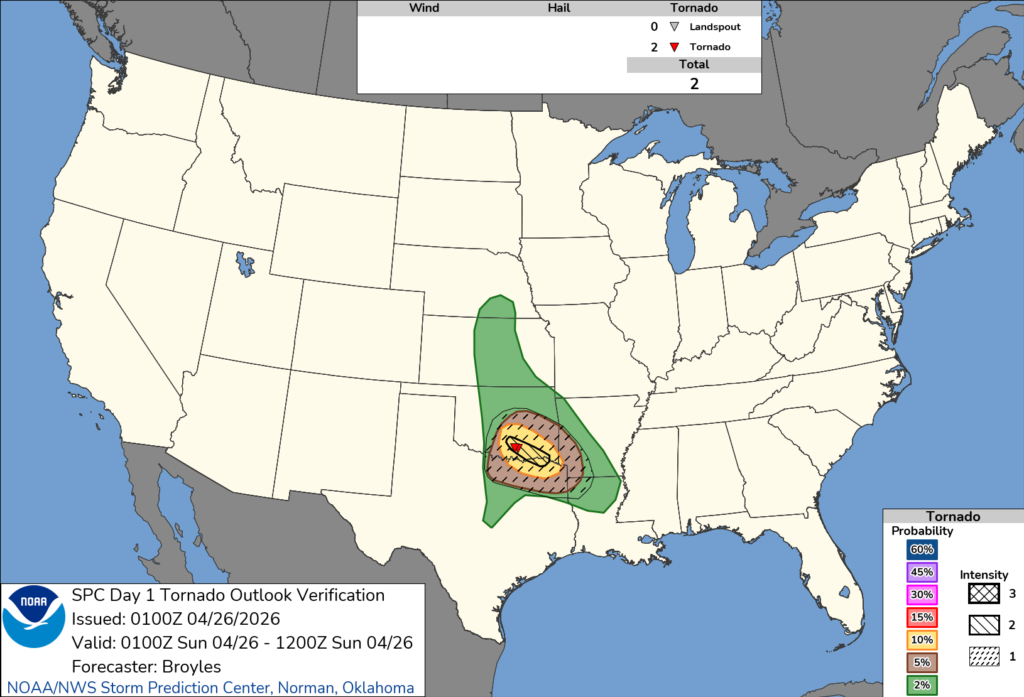
At least 2 people were killed and at least 20 families displaced after tornado-producing storms struck northern Texas, causing major damage to homes in Runaway Bay and Springtown. National Weather Service teams confirmed an EF-2 tornado with peak winds of 135 mph in Runaway Bay and an EF-1 with 105 mph winds near Springtown. The event is materially negative for affected communities and local infrastructure, but it is unlikely to have broad market impact.
The immediate market impact is less about the headline casualty count and more about the reconstruction stack that follows. In North Texas, a tornado cluster that knocks out utilities and blocks access tends to create a multi-week demand pulse across emergency restoration, temporary housing, roofing, roofing materials, power equipment, and local contractors; the beneficiaries are often regionalized and underfollowed rather than the obvious national insurers. The second-order effect is that the same storm path that damages homes can also compress labor availability for nearby commercial projects, which can create short-term revenue pushes for trades but margin pressure from overtime and subcontractor scarcity.
The risk channel is more nuanced for insurers and housing names. The loss severity looks manageable at a system level, but tornado claims can be operationally messy because small-ticket property losses, ALE/temporary housing, and utility-related business interruption can extend settlement timelines and inflate loss-adjustment expenses over the next 1-3 quarters. If this pattern repeats across the Plains/Southwest this spring, the market may begin to reprice catastrophe assumptions for regional homeowners carriers before full season data is visible.
A contrarian read: the market often underestimates how quickly disaster spending can offset local housing damage in public-data prints. Materials distributors, generators, and restoration chains can see same-quarter demand acceleration, while the true negative for housing equities may show up later via permitting delays, tighter underwriting, and elevated replacement-cost inflation rather than the initial destruction itself. The cleaner trade is not to short ‘the storm’ broadly, but to separate insurers with concentrated Texas wind exposure from beneficiary operating leverage in rebuild categories.
Catalyst horizon is days-to-weeks for restoration names and months for insurance reserve revisions. If follow-on severe weather intensifies, the key inflection is whether carriers start signaling higher catastrophe loads in midyear updates; if not, the tape may quickly fade the event as a one-off.
AI-powered research, real-time alerts, and portfolio analytics for institutional investors.
Request DemoOverall Sentiment
strongly negative
Sentiment Score
-0.85
