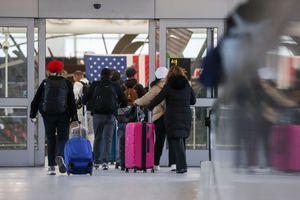
The U.S. Travel Association warned that pulling Customs and Border Protection officers from Newark and other major airports could jeopardize as much as $8 billion a year in tourism revenue. The group said roughly 5 million Americans pass through Newark annually and that halting customs processing could divert or cancel flights, disrupt international cargo, and damage U.S. travel ahead of the FIFA World Cup. The plan is not approved by the White House, but even the threat creates significant downside risk for airlines, airports, and tourism-related businesses.
The market is underpricing the asymmetry between headline risk and actual implementation risk. This is less a near-term earnings event and more a policy volatility shock: if the threat escalates, the first-order damage hits international passenger throughput, but the second-order pain is wider because disrupted inbound flows impair load factors, premium cabins, and connecting-bank economics across the major network carriers. The shared exposure means this is not a simple relative-value issue among AAL/UAL/DAL; the key distinction is route mix, with the carriers most dependent on transatlantic and transpacific origin-and-destination traffic likely to absorb the fastest booking revisions.
The more interesting knock-on is cargo. If customs processing becomes politicized at major gateways, the market should expect a temporary widening in air-freight spreads and a push toward alternative ports of entry, but that substitution is not frictionless and will likely raise dwell times and spoilage risk for high-value imports. That creates a transitory beneficiary set outside the named airlines: express integrators, airport-adjacent warehousing, and potentially ocean freight/port operators if shippers reroute inventory rather than fly it in. The problem is timing—World Cup-related booking windows mean even a low-probability policy threat can depress demand now because groups and corporates plan around operational certainty months ahead.
The contrarian view is that this could be more bark than bite: a federal customs withdrawal would create visible disruption and political blowback, making actual enactment a low-probability event unless it is used as a bargaining chip. If the White House distances itself or Congress pushes back, the trade could reverse quickly, but the reputational damage to airport-city demand could linger for one or two booking cycles. In that scenario, airline equities likely mean-revert, yet near-dated implied volatility may still remain elevated because the policy headline can be revived repeatedly.
Net: this is a short-duration but high-gamma regulatory overhang, not a fundamental collapse in travel demand. The best expression is to buy downside convexity into the next 2-6 weeks rather than press outright shorts into a politically fragile, headline-driven tape.
AI-powered research, real-time alerts, and portfolio analytics for institutional investors.
Request DemoOverall Sentiment
strongly negative
Sentiment Score
-0.70
Ticker Sentiment
