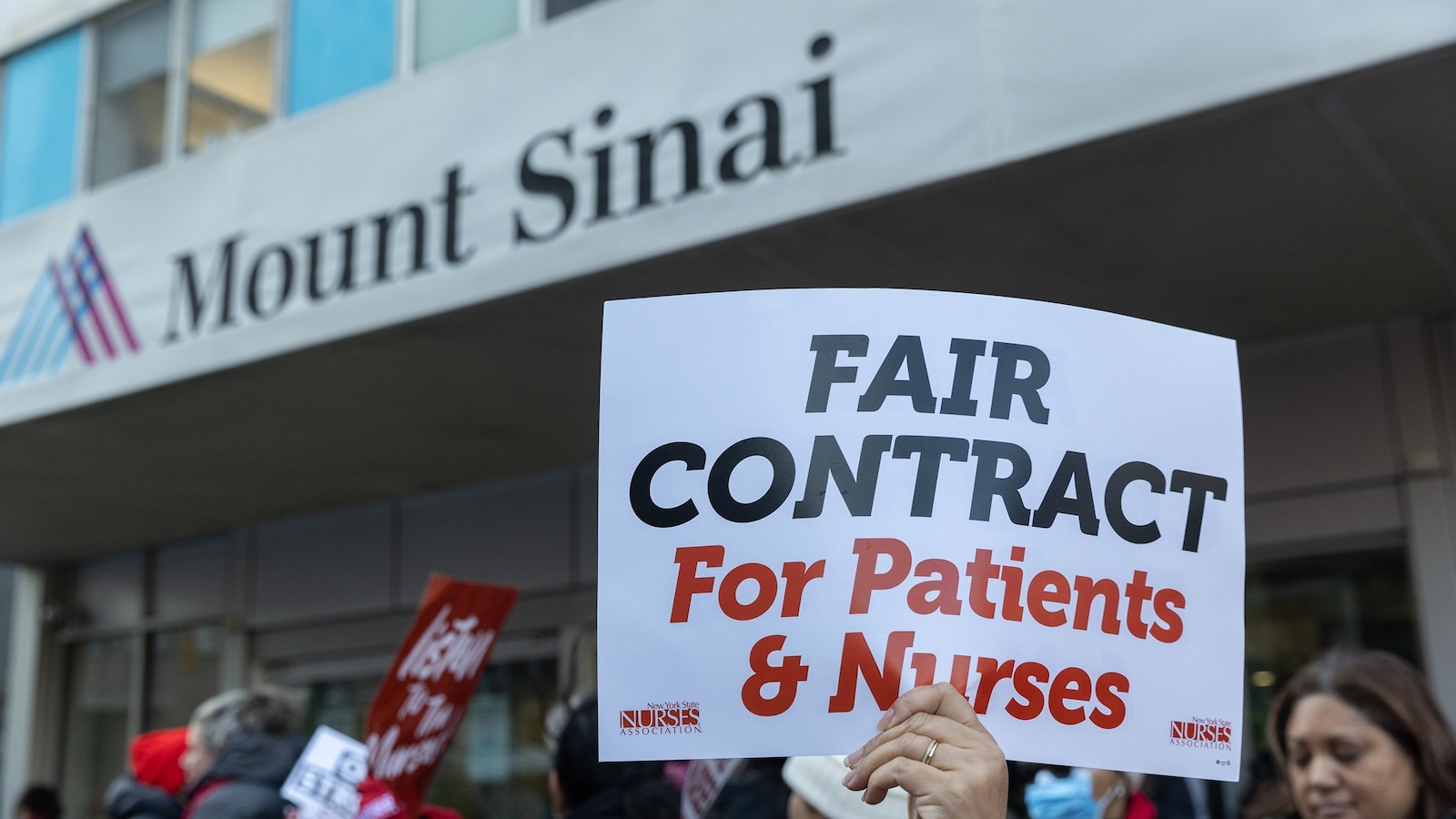
Nearly 16,000 nurses represented by NYSNA are threatening to start what would be the largest nurses' strike in New York City history at 6 a.m. Monday, targeting five major private hospitals: Mount Sinai Hospital, Mount Sinai Morningside, Mount Sinai West, Montefiore Einstein and NewYork‑Presbyterian. The union is demanding pay hikes, safe staffing, full health coverage, pensions and workplace violence protections; hospitals say the union's demands amount to roughly $3.6 billion including a near-40% wage increase and say they are preparing for a potentially multi-week work stoppage while Governor Hochul declared a state of emergency. Operational disruption could reduce elective-procedure revenue and raise contingency costs for affected systems and local healthcare capacity during a flu surge, though limited public-company exposure limits broader market contagion.
Market structure: A protracted NYC nurse strike is a direct negative for private hospital operators' revenue and margins (elective procedures could drop 20–40% in affected facilities over a multi-week strike). Staffing and travel nurse suppliers (AMN) and temp labor platforms will see immediate demand and pricing power; insurers (UNH, CI) could see short-term utilization shifts but limited direct benefit. Cross-asset: expect a near-term flight-to-quality (Treasury bids), wider credit spreads for leveraged hospital systems, and elevated implied volatility in hospital equities and short-dated options.
Risk assessment: Tail risks include a multi-week strike (low-probability but high-impact) that forces hospitals to raise wages 15–40% or triggers state takeover/extra funding; that would structurally compress margins industry-wide. Immediate window (days): operational disruption and IV spikes; short-term (weeks–months): renegotiated labor contracts and possible price pass-through limits from payers; long-term (quarters+): wage precedent could raise industry labor costs 5–15% permanently. Hidden dependencies: Medicaid/Medicare reimbursement rigidity and elective-care cadence; catalyst set: government mediation, tentative deal, flu/COVID caseloads.
Trade implications: Tactical: long staffing (AMN) vs short large hospital operators (HCA, UHS) as a pairs trade; use options to express asymmetry—buy 1–2 month ATM calls on AMN and buy 1–2 month put spreads on HCA. Rotate away from leveraged hospital credits and reduce direct exposure to hospital REITs with high tenant concentration in NYC (e.g., MPW) until contracts settle. Enter within 48 hours of strike start; trim positions on a settlement or after 30 days.
Contrarian angles: Consensus prices systemic catastrophe; history of localized healthcare strikes shows resolution within 1–3 weeks and swift rebound in patient volumes. Risk: staffing firms may lack capacity to scale, capping upside; implied volatility on hospital names may be overbought—consider selling short-dated call spreads if you hold hospital short exposure. Monitor wage settlement magnitudes closely (any agreed increase >15% is the regime-change threshold).
AI-powered research, real-time alerts, and portfolio analytics for institutional investors.
Request DemoOverall Sentiment
moderately negative
Sentiment Score
-0.60
