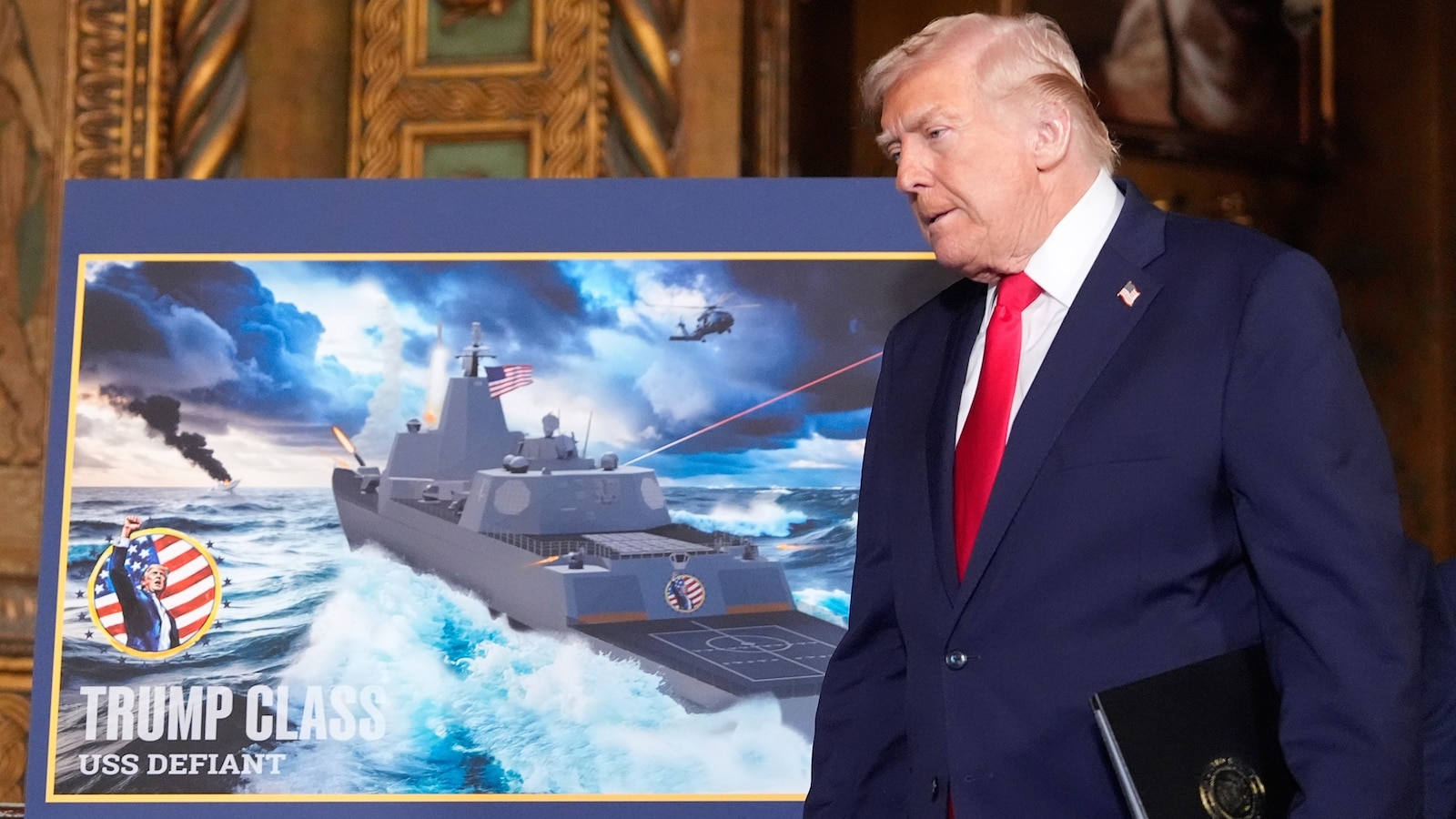
President Trump announced a new 'Trump Class' of very large battleships as part of a proposed 'Golden Fleet,' unveiling two initial ships and a stated goal of 20–25 vessels with a first-ship timetable of about 2½ years; design, build and deployment costs remain undetermined though a retired admiral estimates the first could exceed $10 billion. The ships are described as carrying hypersonic weapons, electric rail guns and high-powered lasers and are pitched alongside broader administration aims to revive domestic shipbuilding, build carriers and submarines, and pressure contractors to invest in plants rather than share buybacks — a development that could benefit defense contractors if funded but carries substantial execution, budgetary and geopolitical uncertainty.
Market structure: Direct winners are domestic shipbuilders and heavy industrial suppliers — Huntington Ingalls (HII) and General Dynamics (GD) stand to gain design/build revenue; steel producers (NUE, STLD) and specialty electronics/actuators suppliers also see multi-year uptick if 20–25 hulls are funded (each hull implied cost >$5–10bn). Losers include firms focused on distributed unmanned maritime systems and any program competing for finite DoD dollars; an administration-level push to curb buybacks also creates asymmetric pressure on buyback-heavy primes' multiples. Risk assessment: Tail risks include Congressional refusal to appropriate funds, cost overruns >30% per hull, or technical failures (railgun/laser/hypersonic integration) that lead to program cancellation — these are low-probability but would trigger >40% downside for direct beneficiaries. Timeline: expect immediate sentiment moves (days), contract/design awards over weeks–months, and multi-year revenue if FY+ appropriations occur over 2–5 years. Hidden dependencies: shipyard capacity, skilled labor availability, rare-earth/advanced semiconductor supply chains and export control constraints. Trade implications: Tactical opportunity: rotate 2–4% portfolio weight from broad aero names into direct shipbuilders and materials. Use defined-risk options (9–12 month call spreads) on HII/GD to capture funding upside while limiting drawdown. Monitor three catalysts in next 60–120 days: DoD design contract awards, FY appropriation language, and any executive orders on buybacks — act on concrete appropriation >=$20bn initial funding. Contrarian angle: The market may price a simple ‘defense rally’ that ignores political funding realities and industrial lead-times; the initial rally is likely overdone if Congress does not codify funding. Historical parallels (e.g., post-Cold War capital ships, Zumwalt DDG cancellations) show large-ship programs are politically fragile — favor short-duration, event-driven exposure and avoid levering long duration risk into uncertain multi-year programs.
AI-powered research, real-time alerts, and portfolio analytics for institutional investors.
Request DemoOverall Sentiment
neutral
Sentiment Score
0.05
