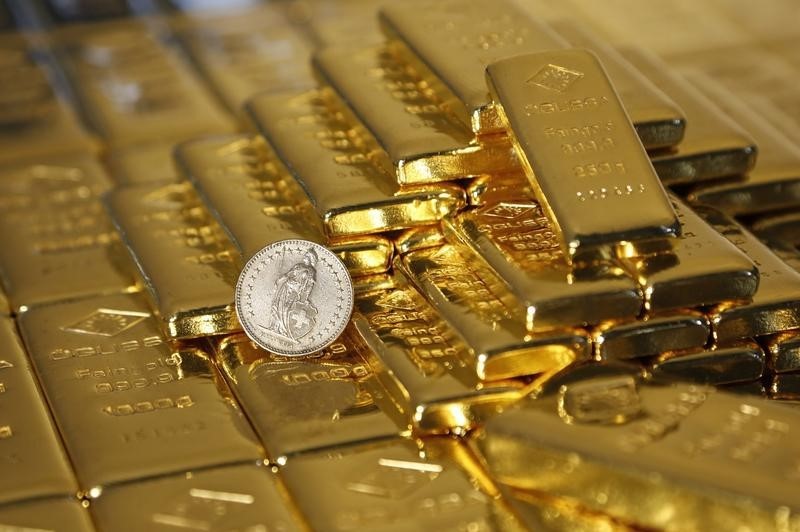
Spot gold fell 1.4% to $4,131.61 an ounce and U.S. gold futures dropped 2.2% to $4,151.10 as the U.S. dollar held near a 13-month high and markets priced about a 90% chance of a December Fed rate hike. Hawkish Fed projections, higher-rate expectations, and a firmer dollar are pressuring non-yielding bullion, while easing U.S.-Iran tensions and a 60-day sanctions waiver also weigh on safe-haven demand. Silver slipped 3.3% to $62.93/oz and platinum fell 2.2% to $1,646.60/oz.
The bigger market implication is not the gold print itself, but the tightening of the real-rate/dollar regime into a window where growth-duration multiples remain vulnerable. That matters most for high-beta secular winners like GOOGL, where the index-level drag is less about business fundamentals and more about the market paying a higher discount rate for long-dated cash flows. For the same reason, the current setup is more favorable for balance-sheet quality and cash-heavy cyclicals than for momentum names that rely on multiple expansion.
A firmer dollar and higher U.S. rates also create a second-order cross-asset headwind for non-US buyers of commodities and AI infrastructure alike. If the dollar stays elevated, imported hardware, energy inputs, and global capex budgets all get tighter at the margin, which can slow spend decisions in the semiconductor and cloud ecosystem; that is a mild positive for firms with pricing power and domestic revenue mixes, but a valuation headwind for names tied to speculative AI narratives. The market is still underestimating how quickly a stronger dollar can become a earnings-revision story rather than just a commodities story.
The most important catalyst is Thursday’s PCE release: if inflation is even modestly sticky, the market will likely move from pricing one hike to debating a follow-on move, which would extend pressure on precious metals and high-multiple equities for several weeks. Conversely, any downside surprise could trigger a sharp squeeze in gold and other rate-sensitive assets because positioning now looks crowded into the hawkish consensus. That asymmetry argues for treating the current move as a regime test, not a one-day commodity reaction.
Geopolitics is the consensus blind spot: the market is treating Iran diplomacy as deflationary for oil, but any perceived thaw that stabilizes energy supply could actually be bearish for gold by removing the inflation hedge bid while leaving real rates elevated. In that setup, gold can underperform even if geopolitical risk remains unresolved, because investors are prioritizing policy tightening over safe-haven demand.
AI-powered research, real-time alerts, and portfolio analytics for institutional investors.
Request DemoOverall Sentiment
mildly negative
Sentiment Score
-0.35
Ticker Sentiment
