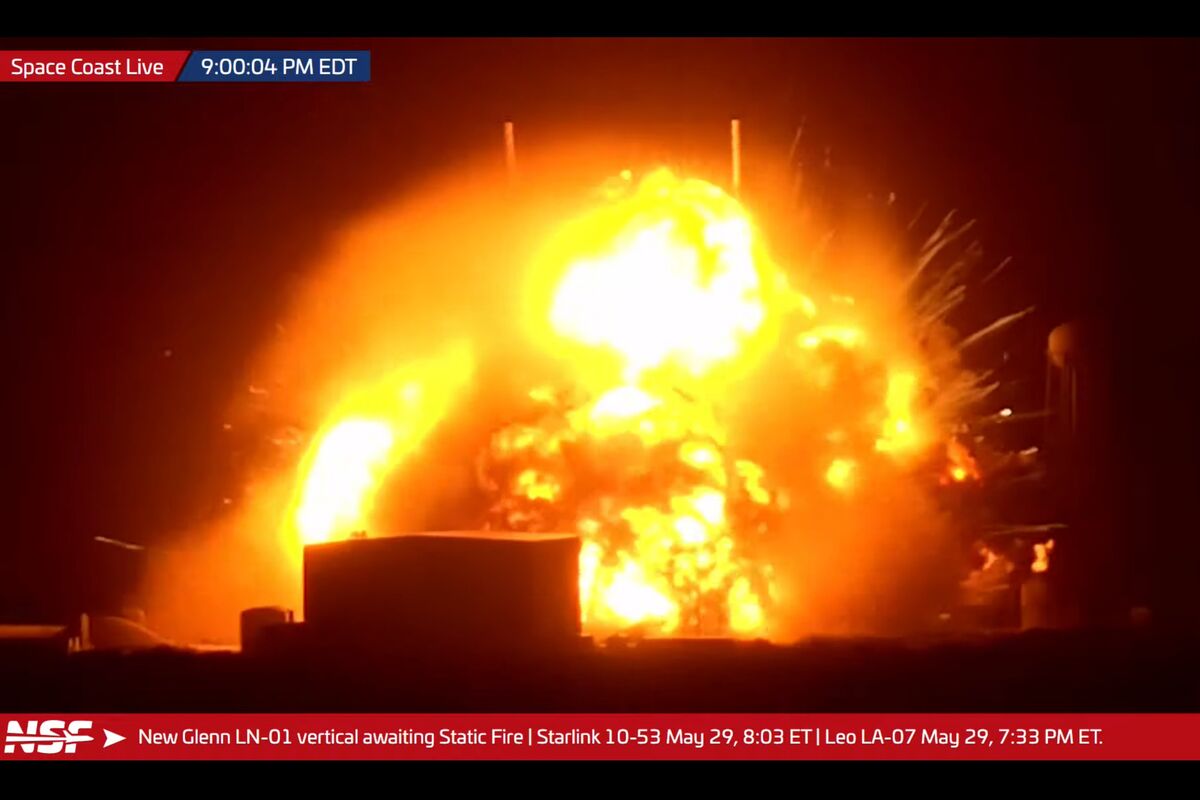
Blue Origin’s New Glenn rocket exploded on a Florida launchpad during a test, marking a major setback for the Jeff Bezos-backed company. The incident comes as the vehicle was being prepared for its fourth launch, which was intended to carry satellites for Amazon’s Leo network, although no satellites were on board at the time. The failure underscores the execution risk in Blue Origin’s effort to challenge SpaceX in commercial launch services.
The immediate loser is not just the launch provider; it is the broader Amazon satellite roadmap because launch cadence is the binding constraint for any early-stage constellation. A failure at the integration/test stage likely forces a multi-month reset in qualification, pushing deployment slippage into the window where the competitive gap versus the incumbent constellation can widen further, especially in customer acquisition and terminal ecosystem lock-in. Second-order, this increases dependence on third-party launch capacity and raises the probability that the constellation operator leans harder on alternative providers, which is costly and can create schedule fragility.
The more important competitive signal is that launch reliability is itself the moat. Every visible failure strengthens the incumbent’s narrative around operational cadence, which can translate into better pricing power with satellite operators, better insurance terms, and greater ability to pre-sell future manifest capacity. For Amazon, the market should worry less about the single event and more about the strategic spillover: delayed deployment means delayed revenue recognition, delayed service footprint expansion, and potentially higher customer churn risk if the network fails to reach critical mass on time.
The bearish impact on AMZN is probably modest in immediate P&L terms but meaningful in strategic optionality, so the stock reaction may understate the long-duration risk. The contrarian angle is that the setback could ultimately accelerate internal capital discipline: management may prefer to de-risk the constellation with more outsourced launch diversity rather than force an aggressive timeline. If that happens, the negative becomes a scheduling issue rather than a thesis break, and the selloff could reverse once a revised launch plan is communicated.
Key tail risk is repeated reliability failure over the next 1-2 quarters, which would push the project from execution setback to structural disadvantage. A cleaner launch success from an alternative provider within 30-60 days would partially repair confidence and cap the downside, but absent that, the market is likely to discount further delays as cumulative evidence of weaker competitive execution.
AI-powered research, real-time alerts, and portfolio analytics for institutional investors.
Request DemoOverall Sentiment
strongly negative
Sentiment Score
-0.68
Ticker Sentiment
