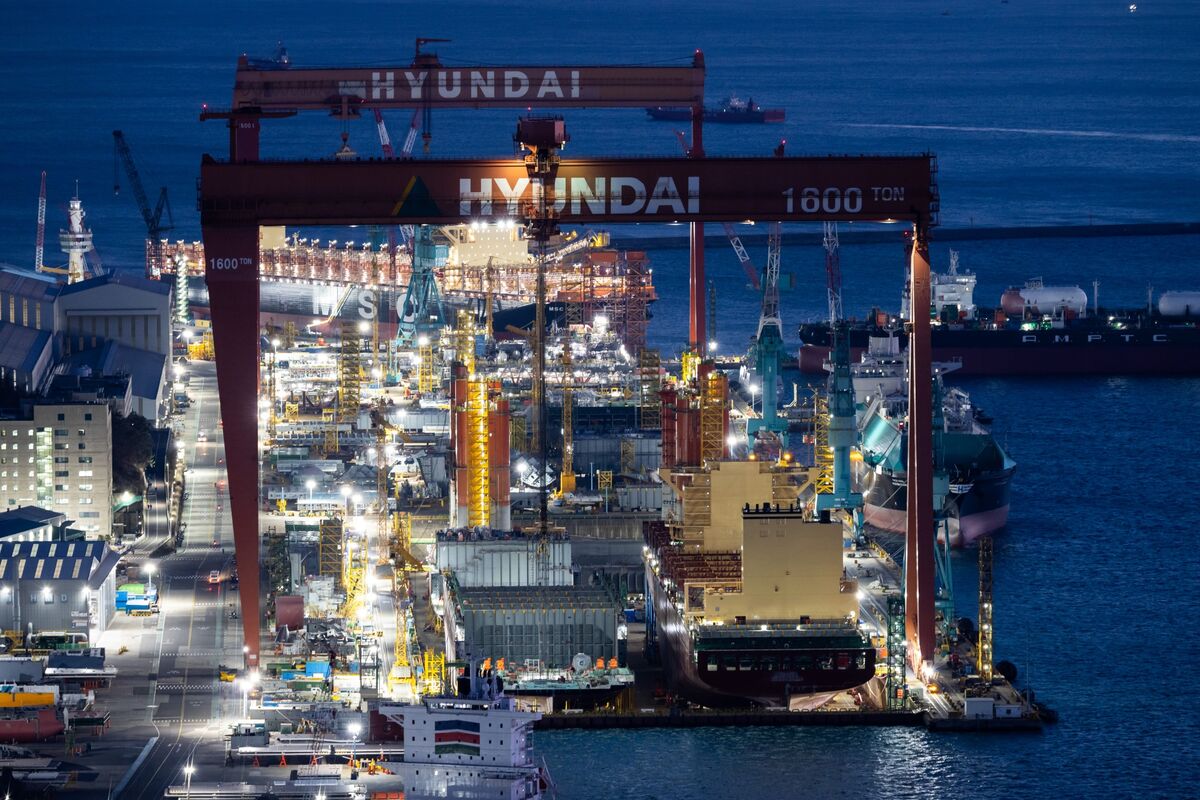
HD Hyundai Heavy Industries says deploying artificial intelligence can accelerate the revival and modernization of U.S. shipyards by combining South Korea's manufacturing expertise with American computing power, positioning the company to support U.S. shipbuilding goals. Seoul aims to deepen strategic relevance and offer an alternative to China, signaling potential increased industrial and technology collaboration between Korean firms and U.S. defense/infrastructure programs, though no contracts or financial figures were disclosed.
Market structure: AI-enabled modernization makes US defense primes (Huntington Ingalls HII, General Dynamics GD) and industrial suppliers (Nucor NUE, Cleveland‑Cliffs CLF) primary beneficiaries as they capture higher‑margin retrofit/new‑build work; AI/compute winners (NVIDIA NVDA, Microsoft MSFT, Amazon AMZN) gain as cloud/GPU demand for digital design/DT doubles. Low‑cost Chinese shipyards and purely commercial ship-operators face margin pressure as onshore modernization raises US pricing power; expect low‑to‑mid single‑digit annualized incremental steel and capital‑goods demand for 2–3 years.
Risk assessment: Tail risks include US export controls on GPUs or a Korea‑US tech spat that could delay key compute supply (high impact, low prob within 6–12 months), and DoD budget/contracting delays (12–18 months). Immediate market moves will be noisy (days), contract formation/partnerships visible in 3–12 months, and meaningful yard productivity gains only apparent over 2–5 years; hidden dependencies include skilled labor, CAM/CAD tool licensing, and cyber certification.
Trade implications: Direct plays — overweight HII (HII) and GD (GD) for 12–24 month contract capture; overweight NUE/CLF for 6–18 months on steel uplift; tactical long NVDA/MSFT exposure (call spreads) for increased GPU/cloud demand. Use 9–15 month call spreads on HII to capture RFP wins while selling shorter-dated calls to finance; consider a small short in ship‑leasing/foreign tonnage (Seaspan SSW) as an asymmetric hedge.
Contrarian angles: Consensus understates implementation friction — shipbuilding productivity gains historically take multiple years (airframe automation parallels), so near‑term earnings improvements are likely muted and partially priced already for AI chip names. Watch for unintended outcomes: cyber vulnerabilities raising certification costs, export controls that would re‑rate NVDA materially; if defense awards slip beyond 12 months, trim cyclicals by 10–20%.
AI-powered research, real-time alerts, and portfolio analytics for institutional investors.
Request DemoOverall Sentiment
mildly positive
Sentiment Score
0.28
