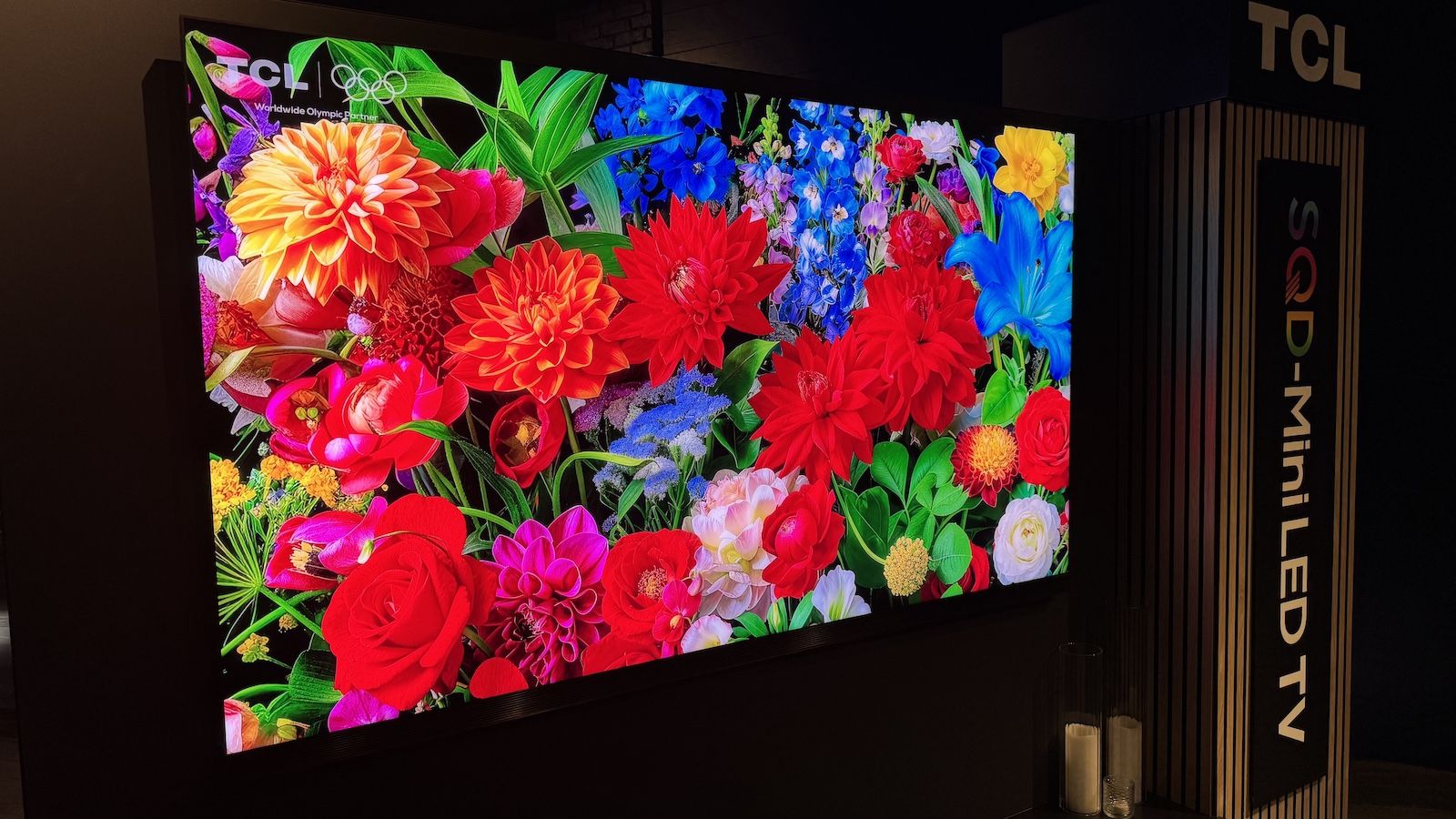
TCL unveiled its 2026 flagship X11L Super QLED TV, a slim-line alternative to RGB Mini LED with claimed peak brightness of 10,000 nits and a record 20,736 local-dimming zones; US launch pricing is $7,000 (75"), $8,000 (85") and $10,000 (98"). The X11L pairs new quantum-dot materials and an 'Ultra' colour filter to deliver higher brightness, more dimming zones, slimmer designs and reduced RGB crosstalk, plus features such as 4K/144Hz (HD/288Hz via Game Accelerator), Dolby Vision IQ/HDR10+, IMAX Enhanced and an integrated Bang & Olufsen soundbar. Early hands-on impressions are positive—highlighting exceptional contrast and brightness versus TCL’s own RM9L RGB Mini LED model—though reviewers note mild off-axis blooming, slightly less pure primary colours, and that final judgment awaits full production samples. For investors, the model signals TCL doubling down on QD manufacturing and a premium pricing strategy that could strengthen its high-end positioning, albeit with limited near-term market-moving impact.
Market structure: TCL’s X11L (Super QD / SQD MiniLED) creates a premium-tier LED alternative to RGB Mini LED and pressures incumbents to match >10,000-nit brightness and >20k dimming-zone claims. Winners are TCL (brand/ASP uplift), QD-material and high-density LED/dimming-IC suppliers; losers include RGB-MiniLED-focused supply chains and mid-tier brands unable to fund R&D. Expect a 6–18 month product-cycle battle that shifts pricing power to firms who control QD patents and fine-grain dimming silicon, compressing margins for commodity panel makers by ~200–500 bps if transition scales rapidly.
Risk assessment: Tail risks include yield problems with new QD chemistry, export/controls on advanced materials out of China, or component shortages raising COGS 10–30% in 3–9 months. Short-term (days–weeks) risk is review-driven sentiment; medium (3–12 months) is channel adoption and retailer stocking; long-term (1–3 years) is patent/legal fights and ecosystem lock-in. Hidden dependencies: availability of high-channel dimming drivers (ICs), factory capacity for fine-pitch backlights, and software (AiPQ) tuning to avoid visible artifacts.
Trade implications: Direct plays: small-to-medium longs in TCL Electronics (1070.HK) and supplier Novatek (3034.TW) to capture display-driver and dimming-IC upside; tactical long IMAX (IMAX) exposure for potential uptick in IMAX Enhanced content licensing to premium displays. Use 9–12 month call spreads on TCL to limit downside and consider a pair trade (long TCL, short LG Display 034220.KS) sized 2:1 for alpha capture if TCL gains retail share.
Contrarian angles: Consensus may underweight consumer resistance to $7k+ TV price points — adoption could be <10% of premium buyers in 12 months, muting revenue upside. Alternatively, the market may underprice the strategic value of 20k+ dimming zones (wall-sized premium installs) driving B2B and commercial orders (hotels/cinemas) over 12–36 months. Watch for cannibalization of TCL’s mid-range ASPs and component-capex spikes as unintended consequences.
AI-powered research, real-time alerts, and portfolio analytics for institutional investors.
Request DemoOverall Sentiment
mildly positive
Sentiment Score
0.35
Ticker Sentiment
