







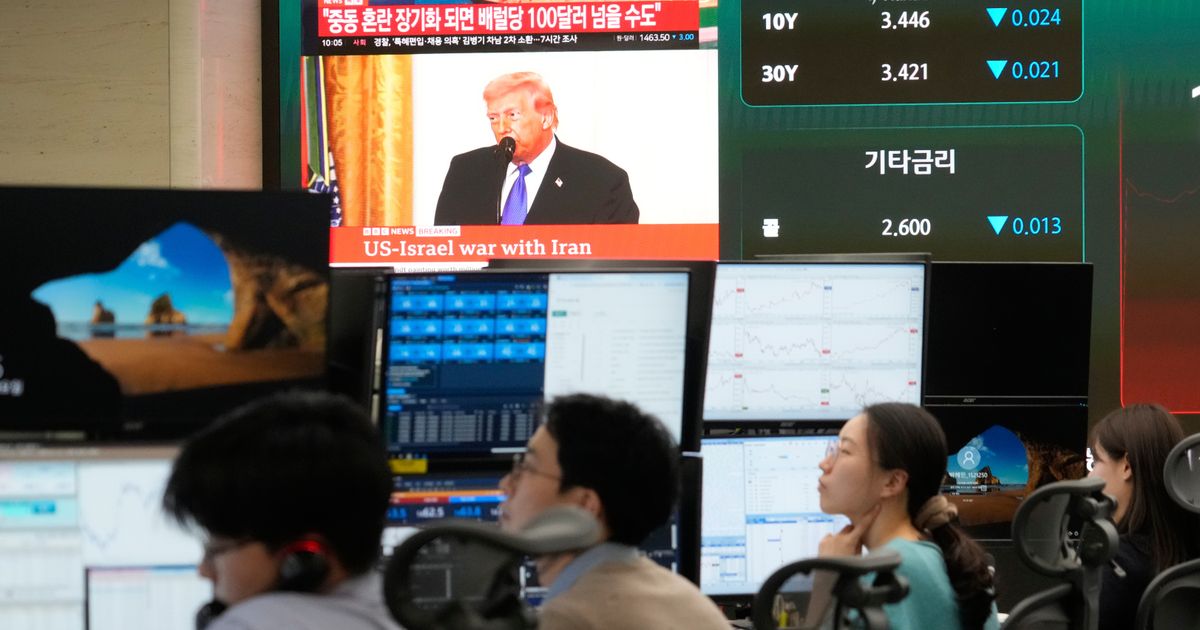
Regional equity markets fell as investors priced in risks to energy supplies from the Iran war: South Korea plunged 4.8% to 5,946.06 and Japan’s Nikkei 225 dropped 2.1% to 56,853.48 while Australia’s ASX 200 lost 1.2% to 9,089.50; airline and Japanese energy stocks were especially weak (Eneos down ~6%, Idemitsu ~4%; ANA -2.4%, JAL -5.2%, Korean Air -8.9%). Oil surged (U.S. crude $72.00/bbl, +$0.77; Brent $78.84/bbl, +$1.10) alongside a 1.2% rise in gold and a rise in 10-year U.S. Treasury yield to 4.04% from 3.97%, while USD/JPY eased slightly to 157.32. The moves reflect a risk-off response to potential Strait of Hormuz disruptions that could tighten supply and influence sector and macro positioning across Asian markets and commodity-sensitive sectors.
Market structure: Energy producers (XOM, MPC, broader XLE) and defense/defense-tech (NOC, RTX, PLTR) are immediate beneficiaries from a geopolitical risk premium; oil rising toward $75 Brent/$72 WTI already re-rates energy margins and airline fuel costs, and a sustained move >$85-$100 would materially shift corporate earnings assumptions. Importers and travel/exposure names (AAL, Asian airlines, Japanese refiners’ customers) are the most direct losers—Korea’s market -4.8% and Japan’s Nikkei -2.1% show sensitivity despite Japan’s >200-day stockpile buffering immediate physical shortages.
Risk assessment: Tail risks include a Strait of Hormuz closure, insurance premium spikes (VLCC tanker rates), or escalation triggering sanctions—each could push Brent >$100 in weeks and choke seaborne supply. Time horizons split: days = volatility and FX/flight-to-safety (gold, JPY, short-term Treasuries), weeks-months = earnings shocks for airlines/consumers if oil >$85 for 60+ days, quarters+ = permanent defense budget increases in Japan/ROK and higher structural energy security spending.
Trade implications: Favor short-dated volatility buys and directional exposure: buy capped upside in large-cap integrated energy and defense names, hedge with puts on airlines and Asian beta. Cross-asset: expect higher oil to lift commodity FX (AUD, CAD) initially, flattening pressure on real yields and forcing central banks to re-evaluate core inflation if shock is sustained; watch 10y Treasury yield moves around 4.0% as a liquidity/tightening signal.
Contrarian angles: Consensus assumes energy shocks are transitory; that underweights the nonlinear risk of shipping-route disruption and insurance-driven cost inflation—markets may be underpricing defense contractors’ multi-year TAM expansion and overpricing short-term airline recovery. If Brent reverts below $70 for 10 trading days, defense/energy longs should be trimmed; if Brent >$90 for 30 days, rotate further into midstream and capitalization-constrained producers.
AI-powered research, real-time alerts, and portfolio analytics for institutional investors.
Request TrialOverall Sentiment
moderately negative
Sentiment Score
-0.45
Ticker Sentiment
