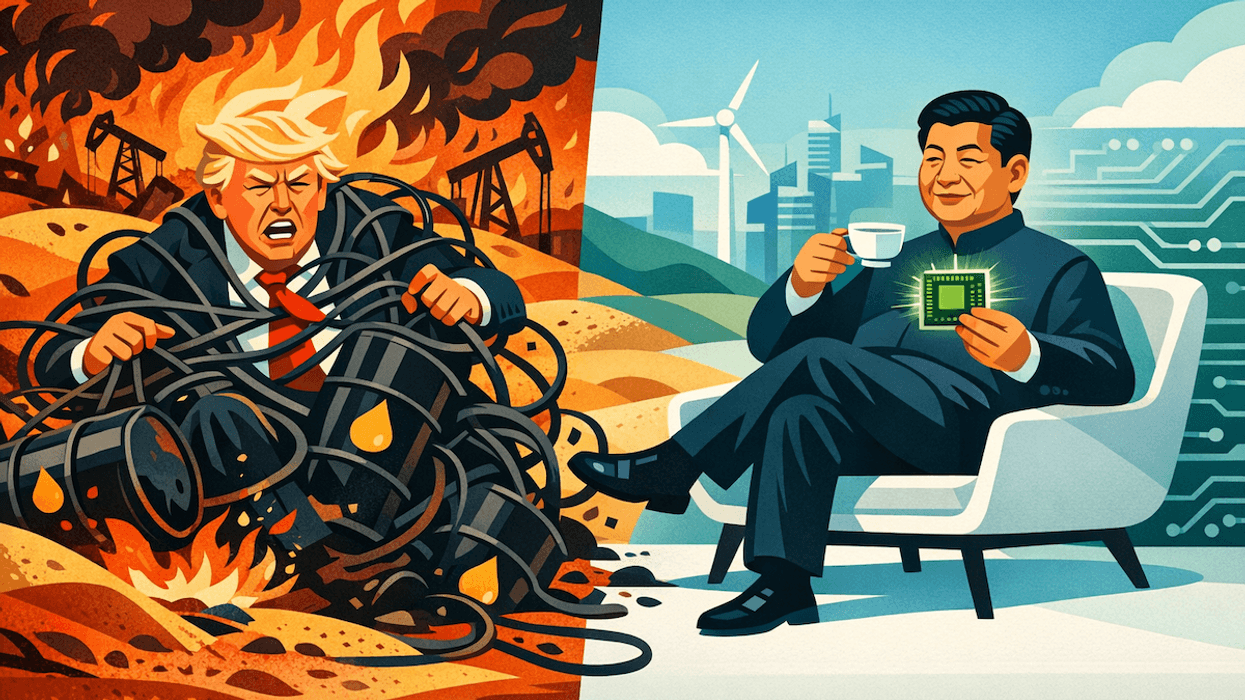
China is presented as a relative winner from the US-Israeli war with Iran, benefiting from ample oil stockpiles, diversified gas supply, and a weaker U.S. military posture. The article says disruptions in the Strait of Hormuz are boosting demand for China’s clean-tech exports and exposing U.S. dependence on Chinese critical minerals, while also increasing incentives for Beijing to seek a negotiated end to the conflict. Risks remain if the war drags on and curtails China’s oil imports from Iran or slows Asian and European demand for Chinese exports.
The market implication is not “China is insulated,” but that this shock is asymmetrically negative for the US security premium and for energy transport chokepoints while being only modestly negative for China’s growth mix. The bigger second-order beneficiary is the electrification stack: sustained shipping risk and higher embedded insurance/transport costs should widen the relative economics of grid, storage, copper, power electronics, and domestic EV demand versus hydrocarbons. That means the trade is less about spot crude and more about capex rotation toward assets that monetize resilience and de-risked supply chains.
The overlooked loser is not just Gulf exporters; it is any Asia-facing manufacturer reliant on stable freight, LNG, or dollar liquidity. If the conflict drags beyond a few weeks, the pressure transmits into Chinese export margins through slower Europe/Asia end-demand and higher input volatility, which can offset some of the near-term energy benefits. In that regime, China’s “winner” status becomes a relative call versus a weaker Middle East and a distracted US, not an absolute macro positive.
The key catalyst is duration. A short conflict reinforces Beijing’s narrative and keeps risk assets contained; a 1-3 month disruption starts to bite China through trade demand and logistics, while simultaneously forcing more visible US stockpile trade-offs in Indo-Pacific defense. The tail risk is a sharp escalation around Hormuz or Taiwan signaling: markets are underpricing how quickly military logistics constraints can spill into semiconductor, shipping, and defense procurement cycles over the next 6-18 months.
Consensus is probably overestimating how quickly China can convert US distraction into strategic gains. Xi’s caution means the regime may optimize for optionality, not aggression, so the more investable angle is that China leans harder into domestic energy transition, dual-use supply chain control, and selective coercive pressure short of war. That is supportive for Chinese clean-tech leaders and for non-Chinese defense names, while being bearish for global cyclicals exposed to trade slowdown and shipping disruption.
AI-powered research, real-time alerts, and portfolio analytics for institutional investors.
Request TrialOverall Sentiment
mildly positive
Sentiment Score
0.15
