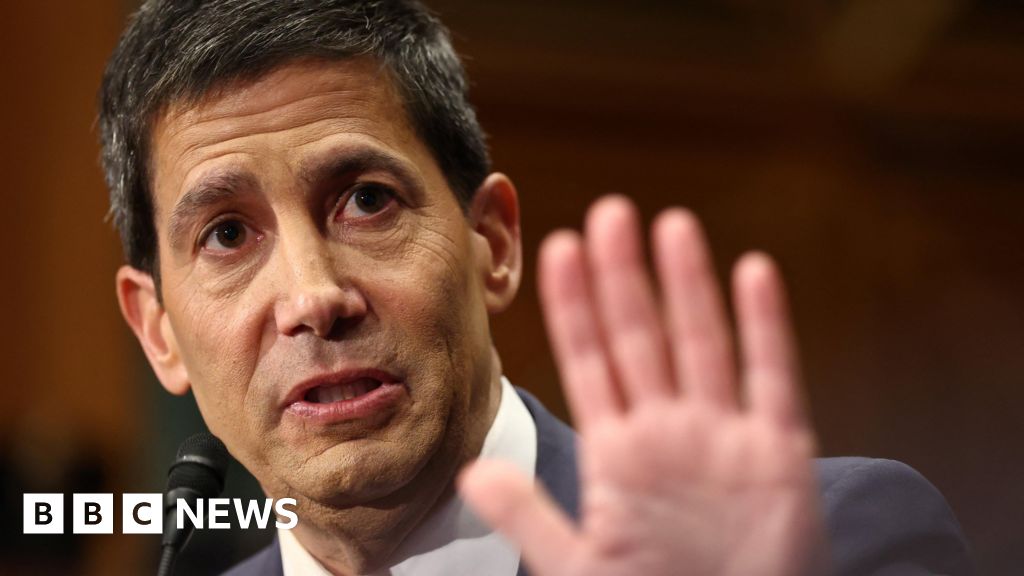
Kevin Warsh faced a combative Senate confirmation hearing as a potential Federal Reserve chairman, with Democrats attacking his independence and links to Trump and Jeffrey Epstein. Warsh denied being Trump's "sock puppet," denied any deal to cut rates, and said he would preserve Fed self-governance while pursuing a new inflation framework and changes to the Fed's communication style. Senator Thom Tillis withheld support pending a probe into Jerome Powell, leaving Warsh's confirmation uncertain and raising the risk of continued Fed leadership disruption.
The market implication is not the hearing itself but the increased probability of a Fed leadership transition that would explicitly pressure the front end of the curve. A credible dovish chair would steepen the policy error distribution: 2-year yields can compress on “lower-for-longer” expectations while term premium on 10s may rise if investors start pricing institutional independence risk and higher inflation variance. That is a mildly bearish setup for USD and real-rate-sensitive assets, but the bigger second-order effect is on financial conditions credibility, which can change faster than actual policy.
The most interesting wrinkle is that a chair who wants a visible regime change at the Fed may create more volatility even if he ultimately cuts rates. Markets usually like easing, but they dislike discretionary communication shifts because it raises uncertainty around reaction functions and inflation targeting. That tends to favor gold, TIPS, and quality duration over cyclicals that need stable nominal growth assumptions. Bank equities are a cleaner short if the market starts pricing an administrative rather than data-driven Fed, because a steeper curve does not offset the hit to NIM visibility and capital-markets multiples from policy noise.
The contrarian read is that this may be less dovish than it sounds over a 6-12 month horizon. If the chair tries to re-earn credibility after political controversy, he could overcorrect with a hawkish bias once in office, especially if inflation measures are revised or re-framed. That makes the event asymmetrically better for owning optionality than for taking outright duration risk: the headline can push yields lower immediately, but the longer-run path depends on whether the new regime is interpreted as easier policy or just less predictable policy.
AI-powered research, real-time alerts, and portfolio analytics for institutional investors.
Request TrialOverall Sentiment
neutral
Sentiment Score
-0.05
