
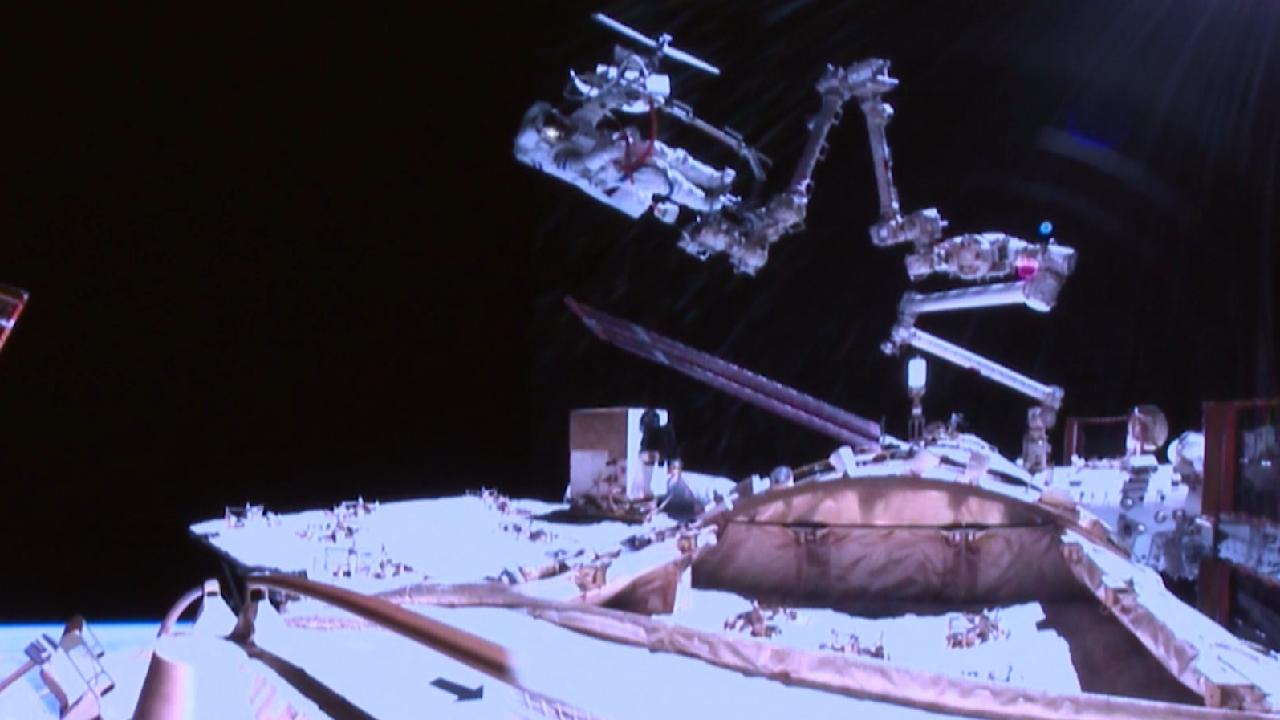
China's Shenzhou-21 crew completed their third EVA after about 5.5 hours, installing a space debris protection device and inspecting exterior equipment and facilities. The mission also set a new Chinese record, with astronaut Zhang Lu logging seven EVAs, and authorities plan to extend the crew's in-orbit stay by about one month. The article is operationally positive for China's space program but has limited immediate market impact.
The incremental signal is not the spacewalk itself; it is the operational confidence implied by extending crew time in orbit and repeatedly executing maintenance without incident. That raises the odds that China is moving from a symbolic station presence toward a genuinely routinized low-Earth-orbit sustainment model, which is strategically important for dual-use logistics, materials handling, and autonomous servicing capabilities over the next 12-24 months.
The second-order beneficiary set is broader than “space” names: precision robotics, radiation-hardened components, thermal management, specialty materials, and ground-command software suppliers should gain the most if China sustains a higher cadence of in-orbit servicing. The underappreciated loser is not a specific listed company here, but the narrative monopoly of NASA-led deep-space capability; repeated clean execution lowers perceived technical risk for Chinese commercial and military-adjacent orbital infrastructure, which can pull future procurement and talent toward domestic Chinese ecosystems.
Near term, the main risk is execution fatigue: the longer the crew remains on station, the more any anomaly becomes a confidence event rather than a routine maintenance issue. Over months, the key catalyst is whether the announced resupply-and-extension pattern becomes a repeatable template; if it does, expect follow-on demand in launch cadence, consumables, EVA hardware, and debris-mitigation systems. A reversal would likely come from a failed EVA, docking issue, or an emergency that forces an early return, which would quickly compress the perceived reliability premium.
Consensus is likely underestimating how much of this is about durability, not exploration. The market tends to price space headlines as binary science news, but the real value accrues when station ops become boring and repeatable; that is the prerequisite for defense, telecom, and ISR adjacency. If China proves it can stretch mission duration and resupply smoothly, the competitive gap narrows in the one area that matters most for long-duration orbital infrastructure: operational cadence.
AI-powered research, real-time alerts, and portfolio analytics for institutional investors.
Request TrialOverall Sentiment
neutral
Sentiment Score
0.15
Ticker Sentiment
