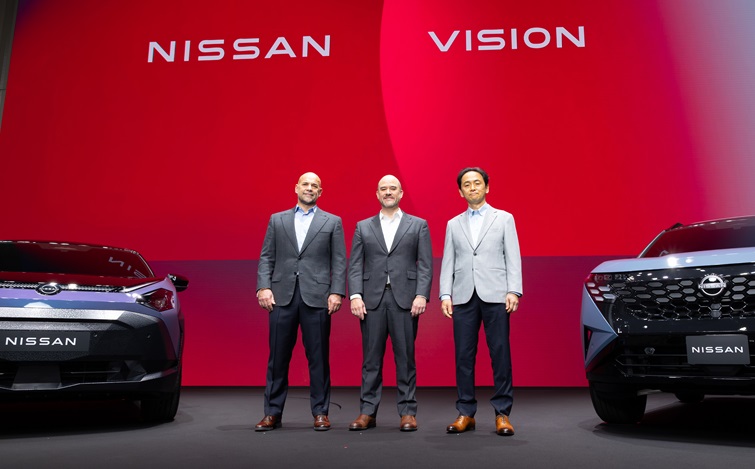
Nissan outlined a long-term strategy centered on AI-defined vehicles, electrification, and a streamlined lineup cut from 56 to 45 models. The company aims to deploy Nissan AI Drive across 90% of its lineup, expand powertrain choices, and lift volume per model by more than 30% through a new product-family industrial model. It also set medium-term targets including 550,000 annual sales in Japan and 1 million annual sales each in the U.S. and China by fiscal 2030.
The equity setup is less about the headline vision statement and more about the sequencing problem: Nissan is asking the market to underwrite a multi-year product and software reset while still executing a recovery plan. That creates a classic “show-me” window where near-term sentiment can improve on narrative, but multiple expansion is capped until the company proves it can convert architecture simplification into faster launches, better mix, and measurable margin lift. The key second-order effect is that a more concentrated platform strategy can improve cash conversion faster than top-line growth, which matters for a balance sheet still being rebuilt.
The biggest competitive implication is in North America and China, where Nissan is implicitly conceding that it cannot win as a broad-based full-line OEM. Instead, it is leaning into a narrower set of vehicles where it still has brand permission: large SUVs, body-on-frame, and electrified hybrids. That should pressure Japanese peers and legacy cross-shopping competitors more than pure EV names; the real threat is to mid-tier incumbents that lack a compelling hybrid or value proposition, especially if Nissan can use e-POWER as a bridge to delay a full BEV spend cycle. Suppliers tied to platform complexity and engine diversity should benefit in the near term, while pure-play EV suppliers risk some demand deferral as the market re-rates hybrids as the lower-risk adoption path.
The contrarian read is that the market may be underestimating how much this is a capital allocation story, not a technology story. A larger mix of hybrids and extended-range solutions can improve volume resilience in the next 12-24 months, but it also delays the point at which Nissan becomes a credible pure software-defined EV challenger. If management over-delivers on portfolio pruning and localization, the stock can re-rate on improved visibility; if not, this becomes another strategic reset that burns time while competitors pull further ahead. The main catalyst path is not the vision itself but evidence in the next two earnings cycles that margin, inventory, and launch cadence are actually inflecting.
AI-powered research, real-time alerts, and portfolio analytics for institutional investors.
Request TrialOverall Sentiment
moderately positive
Sentiment Score
0.35
