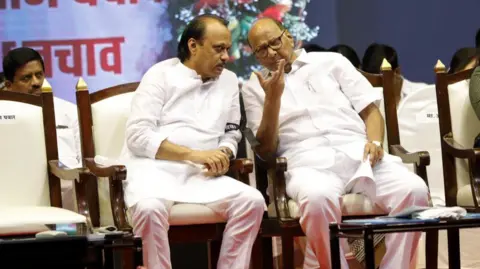
Ajit Pawar, deputy chief minister of Maharashtra, was killed in a plane crash, creating a sudden political vacuum in India's richest state and halting prospects for a potential reconciliation between rival factions of the Pawar family. Pawar had split from his uncle's NCP in 2023, secured the party name and symbol, and built a fragile coalition with the BJP; his death raises near-term questions about leadership succession, the loyalty of defecting lawmakers, and the durability of state-level alliances that could affect policy continuity and investor exposure in Maharashtra.
Market structure: Ajit Pawar's death injects short-term political uncertainty concentrated in Maharashtra — winners are central-government-aligned contractors and large-cap exporters (less state revenue-dependent); losers are regional banks, sugar cooperatives and real-estate/property names tied to Pune/Mumbai that face governance and contract-delay risk. Expect localized spread widening in Maharashtra state/municipal debt (initial move +10–30bp likely) and a 0.5–1.5% knee-jerk INR weakness if by-elections or factional fights escalate. Risk assessment: Tail risks include a protracted power vacuum triggering early state elections or credit-rating pressure on Maharashtra (low-probability but could widen spreads 50–100bp and raise bank NPL provisions). Immediate (days) volatility in state-linked equities and INR; short-term (weeks–months) fiscal uncertainty and by-election outcomes; long-term (quarters–years) depends on coalition consolidation — central fiscal support or symbol/legal outcomes could normalize markets. Trade implications: Tactical plays should favor export/large-cap Indian equities and commodity-sensitive longs (sugar) while de-risking regional-credit exposure and duration in Indian fixed income. Volatility in INR and local spreads creates opportunities for FX forward positioning, short-duration sovereign or steepener trades, and pairs that long exporters (INFY) vs short Maharashtra-exposed banks (HDB) for 1–3 months. Contrarian angles: The market may overprice systemic risk — Maharashtra has historically stabilized quickly after leadership shocks; a disciplined dip-buy into broad India ETFs (INDA/EPI) on a >5% sell-off is a high-IR trade. Conversely, governance gaps at cooperatives could produce idiosyncratic winners (consolidators in sugar/packaging) and losers; avoid blanket sector sells without 30–60 day legal/by-election outcomes.
AI-powered research, real-time alerts, and portfolio analytics for institutional investors.
Request DemoOverall Sentiment
moderately negative
Sentiment Score
-0.35
