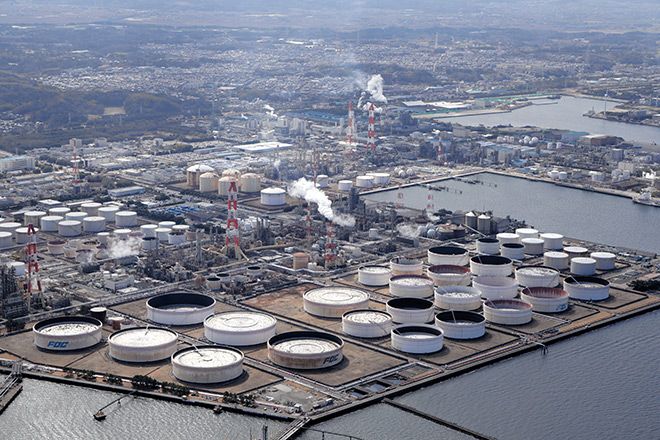
Japan will invest to increase crude oil production in Alaska and stockpile the U.S.-produced reserves as part of a $550 billion tariff agreement with the United States, to be announced by PM Sanae Takaichi and President Donald Trump on March 19. The policy targets Japan's heavy reliance on Middle East oil (about 90% of imports) after Iran effectively blockaded the Strait of Hormuz, prompting the economy ministry to warn of sharply reduced shipments from around March 20. The move should lower Japan's geopolitical supply risk and could have sector-level implications for oil supply flows and prices as Alaskan output and U.S. stockpiles ramp up.
The announced sourcing-shift acts primarily as a tonne-mile shock to the tanker market: shortening average voyage lengths for large Asian crude flows reduces global crude tonne-miles by a non-linear amount, putting immediate downward pressure on spot VLCC/Suezmax rates and freight-linked equities. Expect the freight impact to manifest within weeks in the spot market and to persist for quarters if the program scales, compressing time-charter earnings even as tanker owner balance sheets remain long-term cyclical.
Execution friction will blunt physical supply effects for 12–36 months. New upstream barrels take capital, drilling seasons, pipeline throughput and terminal expansions; meanwhile the first marginal volumes will be parked in storage facilities, creating localized contango opportunities and handing near-term optionality and carry to traders and storage operators rather than to refiners. That means oil price relief will be gradual and concentrated in specific spreads (tanker tonne-mile, spot vs. forward, regional benchmarks) rather than a broad Brent shock lower.
Strategically, the move reshapes leverage between geopolitical actors and private commercial traders: shortening routes reduces the immediacy of chokepoint risk for buyers but increases the economic and political value of North American midstream and service-capex. The biggest tail risks are (a) project delays from permitting/environmental pushback, which would leave markets long on expectations and short on barrels, and (b) renewed Middle East disruption, which would flip sentiment and tanker dynamics in days.
Consensus will likely overstate the near-term oil-supply relief and underweight freight and storage winners. The correct playbook is to trade the infrastructure and freight arbitrages front-loaded to months, while treating upstream equities as a 1–3 year asymmetric payoff if capex execution proves real.
AI-powered research, real-time alerts, and portfolio analytics for institutional investors.
Request DemoOverall Sentiment
mildly positive
Sentiment Score
0.25
