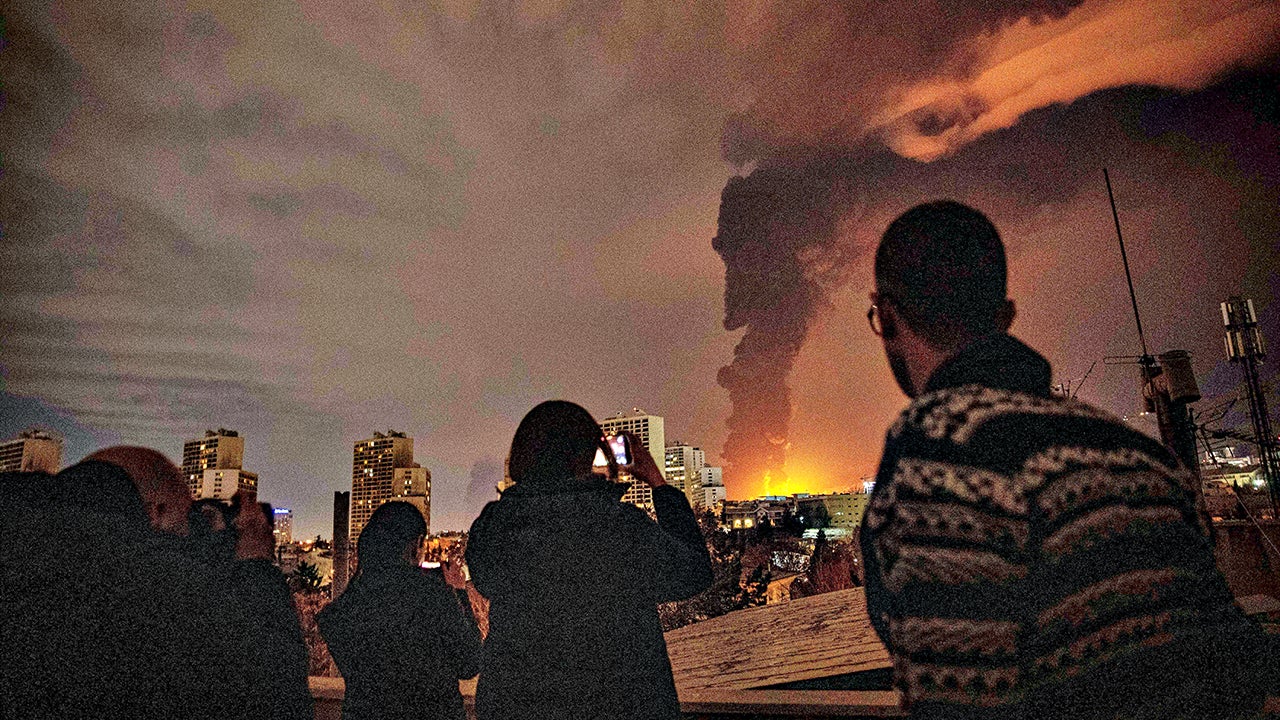
Oil surged above $100/bbl amid the Iran conflict: Brent topped ~$107 (+16.5% vs. Friday close of $92.69) and WTI reached ~$106.22 (+16.9% vs. $90.90), driven by disruptions to production/shipping and risks around the Strait of Hormuz (c.15–20m bpd transits). Military escalation includes Iran’s appointment of Mojtaba Khamenei as supreme leader, multiple missile/drone strikes (including an Iranian drone strike in Bahrain injuring 32 and an Iranian missile intercepted over Turkey), and U.S. forces sustaining casualties, raising systemic geopolitical risk. Expect downstream impacts: jet-fuel supply tightness likely to push airline operating costs and airfares higher, and broader risk-off pressure across markets while energy/security-related sectors reprice for elevated volatility.
The political consolidation in Tehran and ongoing kinetic exchanges materially raise the probability that Gulf transit risk remains elevated for months, not days. That persistence favors assets that capture marginal spreads from disrupted logistics (tankers, refiners with export capability, energy producers with hedged differentials) while penalizing high fixed-cost, fuel-sensitive businesses (airlines, long-haul leisure travel). Insurance and time-charter economics are the transmission mechanism: a sustained spike in war-risk premiums and diverted routing increases cash yields for owners of large crude and product tankers and widens refinery export margins in markets with constrained marine freight capacity.
Near-term (days–weeks) volatility will be dominated by headline shocks and tactical positioning; medium-term (3–12 months) repricing depends on three catalysts — durable closure or throttling of Gulf maritime corridors, coordinated SPR or strategic sales by consuming nations, and a credible diplomatic de-escalation path. Each catalyst has asymmetric impacts: an SPR-style coordinated release caps price spikes quickly but does little to ease insurance/charter spreads; a tactical military success that degrades Iranian strike capacity compresses risk premia over 4–8 weeks; broader conflict escalation forces structural rerouting for quarters.
Consensus positioning looks skewed toward straight energy longs; overlooked is the convexity trade between physical logistics (tankers/terminals) and refined product availability (jet/kerosene cracks). Use option structures to capture upside convexity while capping downside from a near-term ceasefire or policy intervention. Size exposure to reflect two scenarios: 30% probability of protracted disruption (months) and 70% of episodic flare-and-de-escalate outcomes — structure trades to win big if the low-probability severe outcome happens, but limit carry if markets mean-revert.
AI-powered research, real-time alerts, and portfolio analytics for institutional investors.
Request DemoOverall Sentiment
strongly negative
Sentiment Score
-0.70
