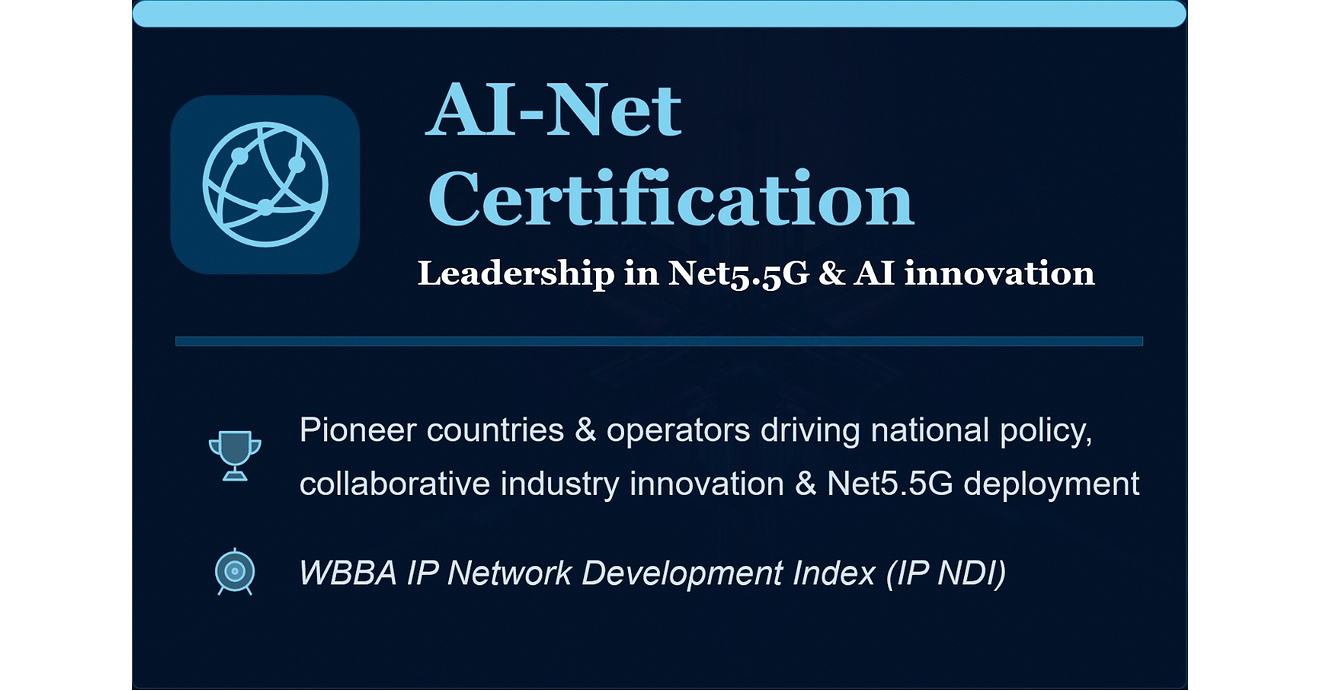
WBBA lanceert tijdens de Asia-Pacific Broadband Development Summit officieel AI-Net, een wereldwijde certificering voor datacommunicatie om Net5.5G-transities te versnellen richting ‘All-Intelligence’. De beoordeling steunt op drie pijlers—nationaal beleidskader, samenwerking binnen het industriële ecosysteem en Net5.5G-penetratie—en bevat macro-criteria plus een operator-score via de IP Network Development Index (IPDI). Het initiatief positioneert netwerken als “Network for AI” en “AI for Network” met focus op voorspelbare prestaties (hoge throughput, lage latency) en geïntegreerde beveiliging.
This is not an earnings catalyst; it is a standards-and-procurement catalyst. The economic value comes only if sovereigns, tier-1 operators, and state-backed capex programs start using the certification as a tender filter, which would favor vendors with end-to-end carrier portfolios and embedded automation tooling. In that scenario, the incremental spend likely accrues first to optical, routing, and network-management layers rather than generic bandwidth products, because the certification rewards latency, determinism, and autonomous operations.
The second-order winner set is broader than the article implies: carriers that can advertise “certified” AI-ready networks can defend enterprise pricing and win higher-margin verticals like logistics, retail, and smart-city contracts. That is supportive for Ericsson (ERIC), Nokia (NOK), and Ciena (CIEN) on the operator side, while datacenter interconnect and high-speed switching names like Arista (ANET) and Broadcom (AVGO) benefit if the standard accelerates east-west traffic and AI cluster buildouts. The losers are legacy transport vendors and smaller point-solution suppliers that sell on bandwidth alone; their pricing power erodes if buyers reallocate budgets toward automation and observability features.
Consensus may be underestimating how long procurement standards take to matter. Near term, the stock impact should be minimal; over 1-3 months, the tradeable angle is any government or carrier capex announcement citing Net5.5G/AI-ready language; over 6-18 months, the real upside is a higher attach rate for software, orchestration, and security, which lifts gross margin mix. The thesis breaks if the certification remains purely promotional and never appears in RFPs or funding criteria; watch for operator guidance, regional telecom capex budgets, and any evidence that AI-network spend is being substituted for broader digital-infrastructure budgets rather than expanded.
AI-powered research, real-time alerts, and portfolio analytics for institutional investors.
Request TrialOverall Sentiment
mildly positive
Sentiment Score
0.15
