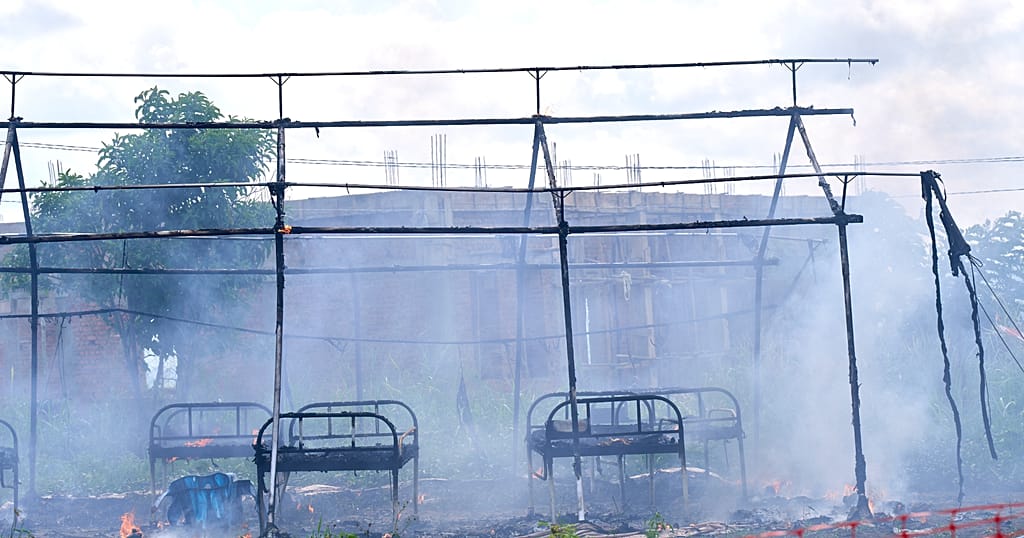
Ebola violence has escalated in eastern DR Congo, with protesters in Ituri province setting a hospital on fire after being denied access to relatives' bodies, while WHO says the latest outbreak has already caused 139 deaths and nearly 600 probable cases. The situation is worsening amid ongoing conflict with M23, which now controls parts of South Kivu and reports a new positive case in Bukavu. The outbreak and insecurity are hampering containment efforts and raise the risk of broader regional disruption.
The market implication is not the disease event itself but the institutional failure around it: once health response becomes entangled with militia governance, containment costs rise nonlinearly and the probability of a geographically wider shock increases. That tends to hit frontier-risk premia first — weaker local currencies, harder funding conditions for regional sovereigns, and a higher hurdle rate for any cross-border project finance tied to eastern DRC logistics, mining, and infrastructure.
The second-order effect is on the mining complex. Even without direct asset damage, recurring unrest in the east raises the probability of episodic road closures, workforce absenteeism, informal checkpoints, and security spending spikes that compress margins for copper/cobalt operators and the service ecosystem around them. The bigger risk is not a one-day disruption but a months-long erosion in export reliability that can force buyers to reprice DRC-origin supply against more stable jurisdictions in the region.
A less obvious loser is regional transport and humanitarian logistics. If border controls tighten and internal movement is constrained, air cargo, cold-chain, and security-linked transport providers can see temporary demand, but only after a lag and with elevated counterparty risk. Over a 1-3 month horizon, the dominant trade is still risk-off: the combination of epidemic uncertainty plus conflict governance creates a feedback loop where each new case raises both public-health and political instability premiums.
Consensus may be underestimating how quickly this can morph from a localized health story into a broader sovereign-risk event. The near-term catalyst is any sign of spread into a major transport node or a breakdown in coordination between local authorities and armed groups; that would likely trigger a sharp but tradable widening in African frontier debt and FX sentiment. The contrarian risk is that headline fear outruns transmission reality, in which case the opportunity is to fade the most obvious panic expressions after the first wave of risk-off flows stabilizes.
AI-powered research, real-time alerts, and portfolio analytics for institutional investors.
Request DemoOverall Sentiment
strongly negative
Sentiment Score
-0.55
