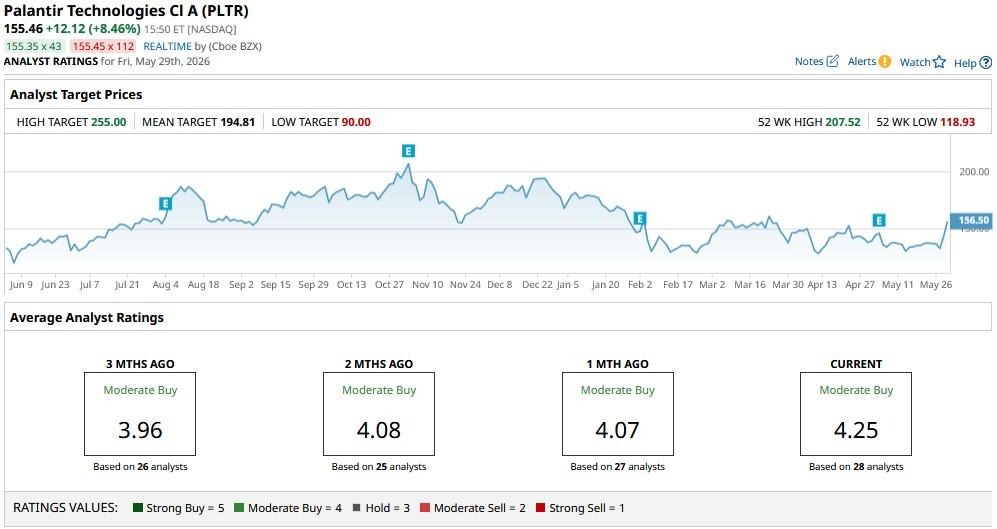
Palantir rose after breaking above its 100-day moving average, helped by Dell’s record $51.3 billion backlog, which reinforces demand for AI infrastructure and could support software spending later in the cycle. Palantir also reported Q1 revenue of $1.63 billion, up 85% year over year, and raised full-year revenue guidance to at least $7.65 billion. Wall Street remains constructive, with a Moderate Buy consensus and a mean target near $195, implying more than 25% upside.
This is less a pure PLTR rerating story than a sign that the enterprise AI spend curve is still in its inventory-build phase, not its monetization phase. Hardware vendors like DELL can print backlog first because buyers can defer software workflow decisions until the data center is installed; that sequencing creates a second-order tailwind for application-layer names with deployment-heavy products. The market is starting to price PLTR as a beneficiary of the next budget cycle, but the more important implication is that AI capex remains broad enough to support multiple layers of the stack, not just chips and servers.
Technically, the move back above the 100-day is meaningful only if it holds through month-end and into the next liquidity window; otherwise it risks becoming a reflexive squeeze off a crowded short base. The setup is most attractive over the next 4-8 weeks because momentum, seasonal support, and the narrative spillover from DELL can overlap before fundamentals need to re-assert themselves. If PLTR fails to convert this into sustained relative strength versus software peers, the market will treat it as a beta trade on AI sentiment rather than a durable earnings-driven rerating.
The main contrarian concern is that investors are extrapolating enterprise AI infrastructure spend into software demand too quickly. There is often a lag, but lagged demand is not guaranteed demand: CIOs may first amortize hardware, delay platform commitments, or route spend to incumbents with bundled suites and lower switching friction. The upside case remains intact, but the stock likely needs continued evidence of deal flow acceleration rather than just validation from upstream capex to justify further multiple expansion.
From a risk standpoint, the move is vulnerable to any sign that AI capex is becoming more selective or financing-sensitive, since that would hit the second-order software beneficiary trade first. If macro conditions tighten, PLTR could quickly revert to being a high-duration multiple name, where even good growth can be sold if forward bookings or customer concentration disappoint. That creates a clean tradeable distinction: short-term momentum is favorable, but the durable thesis depends on conversion of infrastructure spend into actual enterprise workflow deployments over the next 1-2 quarters.
AI-powered research, real-time alerts, and portfolio analytics for institutional investors.
Request DemoOverall Sentiment
moderately positive
Sentiment Score
0.68
Ticker Sentiment
