
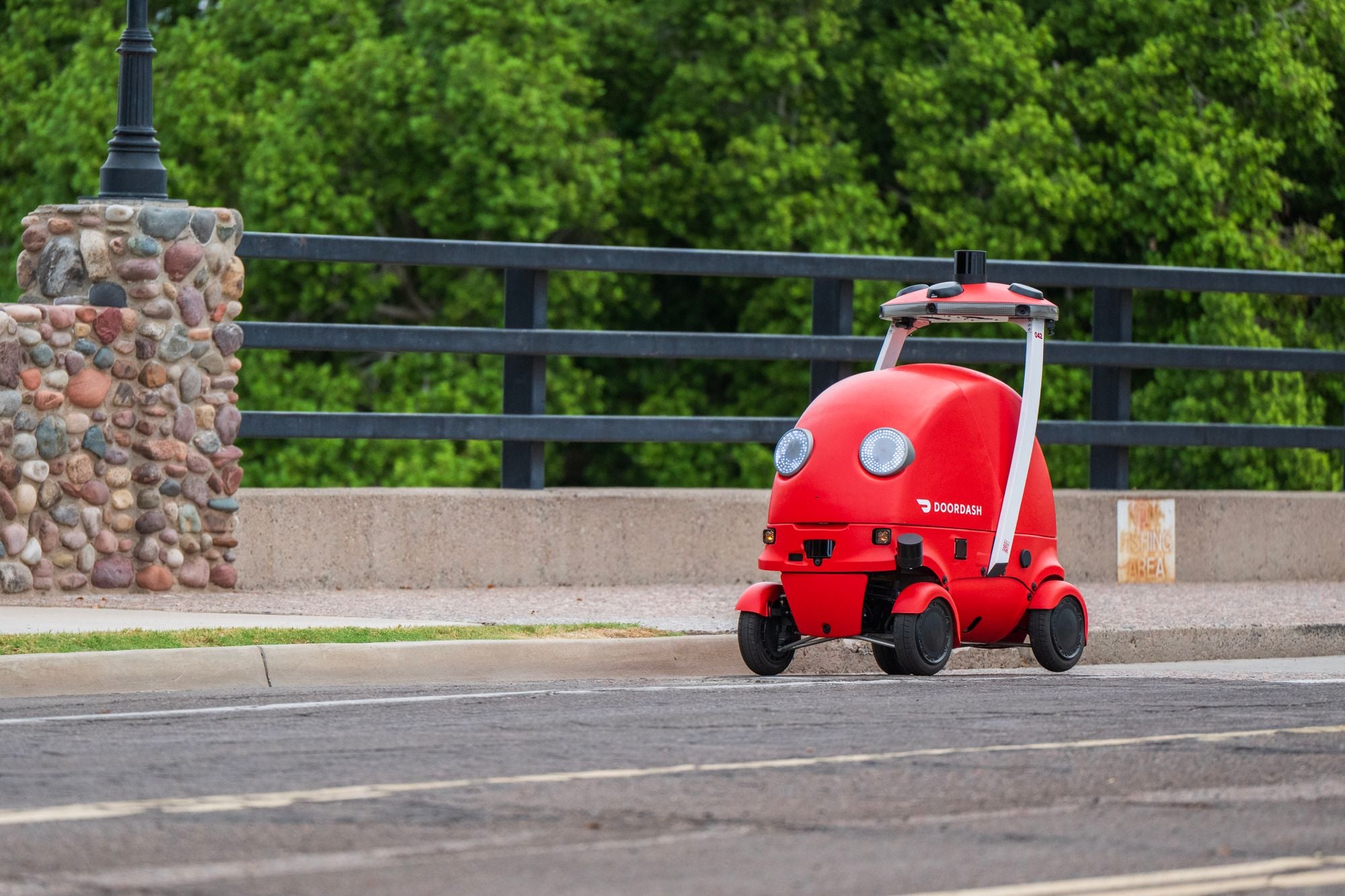
DoorDash will begin operating its autonomous delivery robots ('Dot') in Fremont starting Thursday, March 5, after the city approved permits for up to 30 robots to operate without human chaperones across Downtown/Central, Centerville and Irvington, including corridors such as Fremont Boulevard and Paseo Padre Parkway. The limited rollout—adding to prior use in Phoenix and concurrent drone tests—signals a measured push to lower delivery labor costs and test regulatory, safety and public-acceptance constraints; given the small scale and local scope, near-term financial impact on DoorDash's revenue and margins is likely modest.
Market structure: DoorDash (DASH) gains a marginal competitive edge from robot rollouts—beneficiaries include DASH, AI/compute suppliers (e.g., NVDA) and vision-chip vendors (e.g., AMBA) while gig workers and pure human-dependent couriers (UBER Eats) face margin pressure. At scale (multi-thousand robot fleet), unit labor cost could fall 10–30%, improving EBITDA margins by 3–7 percentage points, but the Fremont pilot (30 robots) is economically immaterial near-term. Cross-asset: expect modest rise in implied volatility for DASH options on positive/negative pilot news; sovereign/corporate bond markets unaffected unless capex ramps meaningfully increases leverage across the sector.
Risk assessment: tail risks include municipal bans, vandalism liabilities, defective-AI accidents and chip shortages; any of these could erase projected savings and trigger litigation/regulatory fines. Time horizons: immediate (days) = PR/noise; short-term (1–6 months) = pilot KPIs (uptime, cost/delivery, theft rate); long-term (2–5 years) = real margin impact if robots reach 10–20% of deliveries. Hidden dependencies: sidewalk mapping, insurance pricing, and local enforcement determine scalability; catalysts: city permits expansion, published cost-per-delivery delta >10%, or partnerships with robotics suppliers.
Trade implications: avoid headline-chasing longs; establish a measured 2–3% long in DASH equity for 12–24 months and scale to 4–6% only if the company reports >10% cost-per-delivery improvement or expands beyond 3 cities within 12 months. Use 12–18 month call spreads on DASH to capture upside while capping premium; buy 1–2% NVDA (secular AI exposure) and consider a matched 1–2% short in UBER as a relative-value trade, unwind if UBER pivots to robotics. Hedge positions with short-dated puts sized 25% of equity exposure if any major city announces a ban within 60 days.
Contrarian angle: consensus overstates near-term disruption—robot economics are capital-intensive and ROI likely 3–5 years, so immediate stock moves are noise. The market may underprice the risk that robots increase fixed costs and depress short-term free cash flow; selling near-term call premium after positive headlines and buying longer-dated downside protection is a higher-probability income strategy. Historical parallel: earlier automation waves (warehouse robots) improved productivity but did not eliminate labor costs for years; expect a similar multi-year, incremental adoption here.
AI-powered research, real-time alerts, and portfolio analytics for institutional investors.
Request TrialOverall Sentiment
mildly positive
Sentiment Score
0.25
Ticker Sentiment
