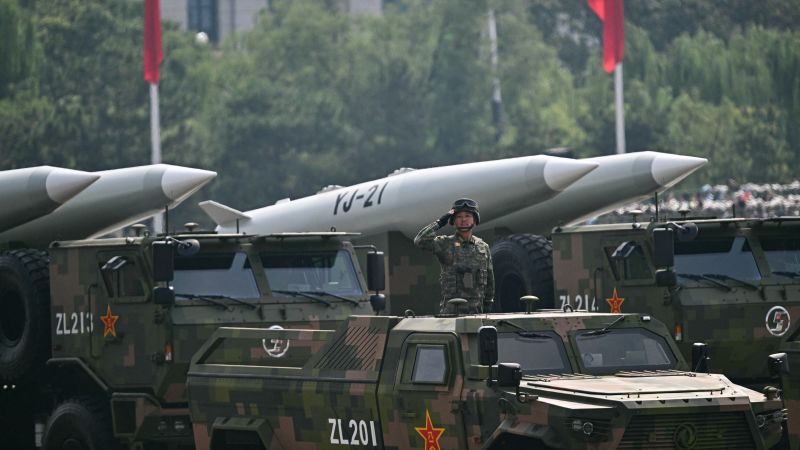
China's recent military parade showcased its rapidly advancing military capabilities, including new ICBMs, hypersonic weapons, and operational directed-energy systems and drones, signaling its significant industrial capacity to develop and deploy high-tech arms at scale. This display underscores China's strategic intent to assert a new world order, supported by a defense budget that has increased 13-fold in 30 years and a projected naval fleet 48% larger than the US by 2030, rapidly narrowing the technological and numerical gap with Western powers despite the PLA's limited combat experience.
China's recent military parade provided a material demonstration of its accelerating military-industrial capabilities and strategic ambition, signaling a significant narrowing of the technological and numerical gap with the United States. The display of new systems like the DF-61 ICBM, hypersonic glide vehicles, and a diverse range of operational drones underscores a shift towards what analysts term 'intelligent warfare'. Critically, the showcasing of mobile, deployed directed-energy laser weapons indicates a move from theoretical development to fielded capabilities that could challenge adversarial air power. This hardware advancement is supported by a defense budget that has increased 13-fold in 30 years and an industrial base capable of mass-producing advanced systems indigenously, a key strategic advantage. Projections of China's naval fleet becoming 48% larger than that of the US by 2030 highlight the shifting balance of power in the Indo-Pacific. However, analysts temper this view by noting the PLA's lack of recent high-intensity combat experience, a critical unknown compared to the US military's proven operational effectiveness, leaving the real-world combat value of this new hardware as an open question.
AI-powered research, real-time alerts, and portfolio analytics for institutional investors.
Overall Sentiment
moderately negative
Sentiment Score
-0.50
