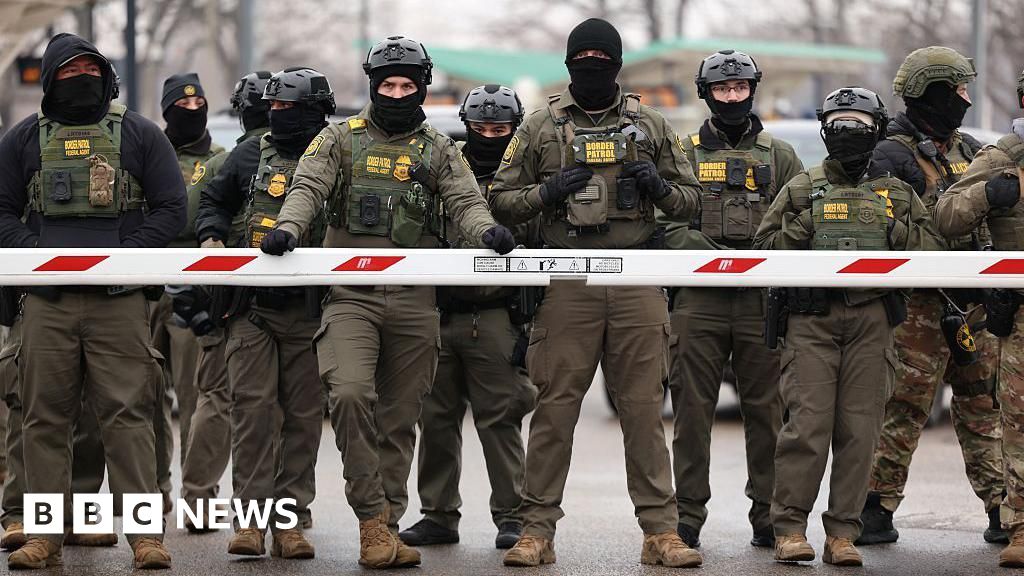
The Department of Homeland Security has ordered body cameras for all federal immigration officers deployed in Minneapolis effective immediately after the fatal shooting of Alex Pretti—whose death was ruled a homicide—and amid the earlier death of Renee Good; CBP says the two agents involved in Pretti's shooting wore body cameras and have been placed on leave while the DOJ opens a civil-rights investigation. The move could be expanded nationwide pending funding as Democrats press for immigration reforms and device mandates as part of negotiations to end a partial government shutdown; the article also notes operational and leadership shifts in the Border Patrol and that Congress previously authorized roughly $80 billion for immigration enforcement. Investors should view this as a politically driven policy development with limited direct market impact but increased political and legal uncertainty around federal immigration operations.
Market structure: The immediate beneficiaries are integrated body‑camera hardware + cloud evidence vendors (Axon-like players) and enterprise security/cloud providers; incumbents with end‑to‑end SaaS (hardware recurring revenue) gain pricing power if federal procurement favors turnkey solutions. Municipalities and smaller camera-only vendors face margin pressure because federal contracts prioritize interoperability, chain‑of‑custody and long‑term cloud fees; ICE’s $80bn scale last year signals procurement budgets large enough to move shares if even a small percentage is allocated to bodycams and evidence management.
Risk assessment: Tail risks include a prolonged appropriations impasse (shutdown) delaying contracts, DOJ civil‑rights litigation changing technical specs or increasing compliance costs, and privacy/state bans shrinking TAM. Timeline: immediate (days) for political/PR volatility; weeks–months for RFPs and appropriation language to surface; multi‑year for contract rollouts and recurring SaaS revenue. Hidden dependency: award winners must demonstrate secure cloud ingestion and e‑discovery integrations—hardware wins without cloud lock‑in are low lifetime value.
Trade implications: Favor select long exposure to AAXN (market leader in body cams + evidence cloud) and MSI (enterprise/public safety comms/hardware) while hedging political funding risk with small cash‑collars or buy‑writes. Use 6–12 month call spreads on AAXN to express upside while capping premium; size initial exposure 1–2% NAV and scale to 3% on concrete contract awards >$100m. Short/avoid pure hardware-only small caps that lack SaaS revenue; expect higher M&A noise and multiple expansion if federal rollout begins.
Contrarian angles: Consensus underestimates recurring cloud revenue versus one‑time hardware sales—if DHS pursues evidence‑management cloud buys, lifetime revenue per officer could be 3x hardware alone (hardware $300–700/unit vs cloud $100–300/yr). Historical precedent: post‑2014 bodycam acceleration boosted integrated vendors over 24–36 months; however, privacy litigation or state pushback remains a plausible dampener. Watch SAM.gov and appropriation text for the inflection point rather than headlines.
AI-powered research, real-time alerts, and portfolio analytics for institutional investors.
Request DemoOverall Sentiment
neutral
Sentiment Score
-0.10
Ticker Sentiment
