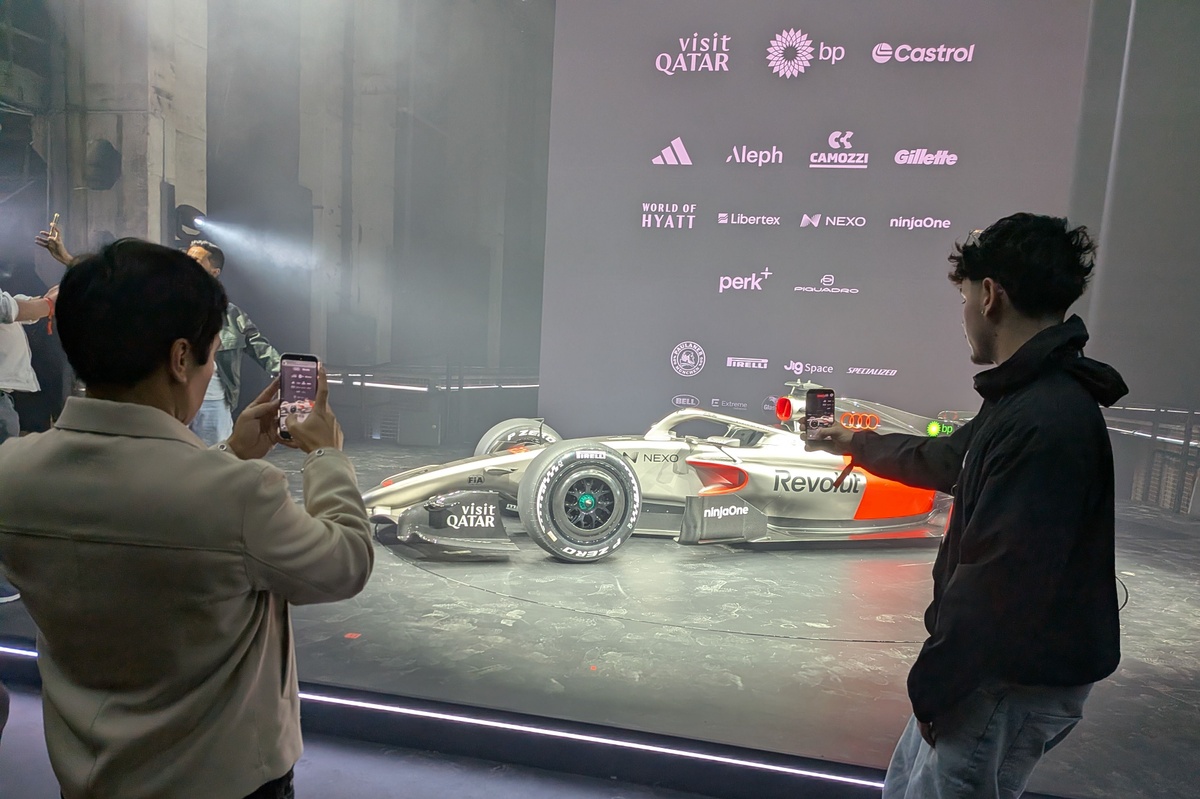
Audi formally launched its Formula 1 programme in Berlin, unveiling its 2026 show car and presenting a strategic roadmap titled “Mission 2030” with the explicit goal of winning championships by 2030. The event underlined a measured, resource-backed approach—public-facing leadership includes Mattia Binotto, Jonathan Wheatley and technical confirmation from James Key—and confirmed an 18-month-planned shakedown of the R26 and Audi’s first F1 power unit in Barcelona. The announcement is primarily strategic and brand-focused with limited near-term financial data or market implications, though it signals ongoing capital allocation to motorsport and potential long-term technology and marketing upside for Audi/VW.
Market structure: Audi’s formal F1 entry is a small direct revenue story for Volkswagen (VWAGY / VOW3) but a medium-impact demand signal for high-performance suppliers (Infineon IFX.DE, STMicro STM, Brembo BREM.MI, carbon-composite vendors). Winners are specialist powertrain and electronics suppliers who can command 5–15% premium pricing on bespoke parts; losers are lower-end ICE component makers (some Continental lines) facing capex reallocation. Cross-asset: expect negligible sovereign FX moves, slight tightening of EUR credit spreads for high-quality German industrial credits if investor sentiment improves; commodity effects (aluminum, carbon fiber) will be immaterial at <1% incremental demand.
Risk assessment: Tail risks include major PU reliability failures, a costly multi-year R&D overrun (>€1–2bn) that forces board reallocation, or regulatory scrutiny on intra-group subsidies; probability low-medium but impact high. Immediate (days) is media-driven volatility; short-term (3–12 months) is supplier contract announcements and early shakedown reliability data; long-term (2026–2030) is championship performance that materially affects brand premium. Hidden dependencies: Audi’s F1 success hinges on third-party chip supply, PU homologation rules and the effectiveness of tech transfer to road EVs.
Trade implications: Direct plays: establish a 1–2% long position in VOW3/VWAGY (12–24 month horizon) to capture branding and tech halo, size to achieve 200–400 bp portfolio exposure. Buy 2–3% exposure to Infineon (IFX.DE) or STMicro (STM) as leveraged beneficiaries of power electronics demand; consider 12-month call spreads (buy 12-mo 25% OTM call, sell 40% OTM) to cap cost. Pair trade: long IFX.DE, short Continental (CON.DE) 1–2% each to express secular shift to high-margin semiconductors vs legacy auto parts; set stop-loss at 10% on either leg.
Contrarian angles: The market underestimates non-linear tech transfer—successful F1 PU IP could raise VW’s EV gross margin by 100–200 bps by 2028 (consensus misses this). Conversely, the headline hype overstates near-term equity upside; if Audi stumbles in 2026, VW shares could drop 8–12% on reputational and headline risk—use options to asymmetrically express views. Historical parallels (Honda’s F1 cycles) show brand halo but limited direct EBIT; monitor 3 concrete catalysts (supplier deals, Barcelona shakedown telemetry, VW capex guidance) in next 6–9 months to validate thesis.
AI-powered research, real-time alerts, and portfolio analytics for institutional investors.
Request DemoOverall Sentiment
neutral
Sentiment Score
0.10
