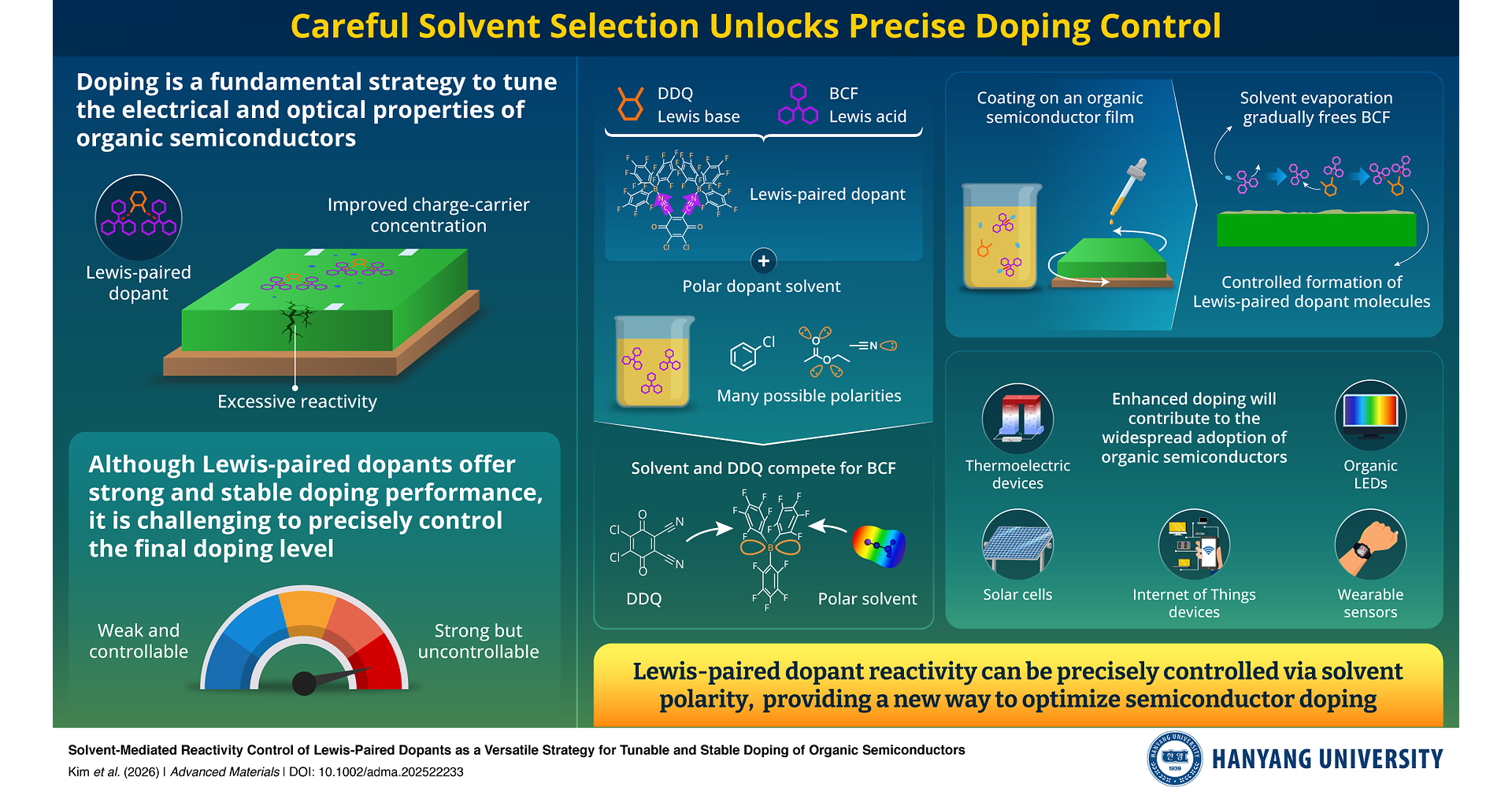
Hanyang University researchers report a solvent-polarity method to achieve strong, controllable, and stable doping in organic semiconductors using Lewis-paired dopants (DDQ and BCF). By using moderately polar solvents like ethyl acetate, BCF release during processing is tuned to fine-adjust doping levels without damaging the semiconductor film or changing dopant chemistry, enabling doping across chemically difficult materials and improving thermoelectric metrics (thermoelectric power factor and Seebeck coefficient). The work is positioned as a practical pathway toward higher-performance, stable organic electronics for self-powered wearables and low-power sensors, but no direct commercial or financial figures are cited.
This is more important as a manufacturing-enablement signal than as a product breakthrough. The economic value shifts toward firms that can turn flexible/printed organic electronics into repeatable yield, because controllable doping reduces one of the last process-variable bottlenecks; the moat moves from molecule design to formulation, coating, and quality control. That favors established materials/IP holders and OEMs with real pilot lines, while pure-play concept names in wearables still have to prove they can monetize the chemistry.
Near term, I would not expect this to change any P&L by itself. The first tradable effect is sentiment for the small-cap wearable/organic-sensor complex, but the fundamental catalyst path is 1-3 quarters of follow-on patents, pilot-scale roll-to-roll demos, and customer sampling. The main failure mode is the lab-to-fab gap: if the solvent window only works on small-area films or breaks under humidity/thermal aging, the commercial relevance stays academic for 6-18 months.
The contrarian miss is that the upside may be in lower-cost processability rather than headline performance. If that is right, incumbents with existing coating capacity can adopt it quickly, which actually compresses the moat for speculative device makers instead of expanding it. For WLDS specifically, this is not yet a revenue catalyst; the right way to think about it is as a watch item for whether management can show any organic/self-powered sensor roadmap tied to real customer demand.
AI-powered research, real-time alerts, and portfolio analytics for institutional investors.
Request DemoOverall Sentiment
moderately positive
Sentiment Score
0.35
Ticker Sentiment
