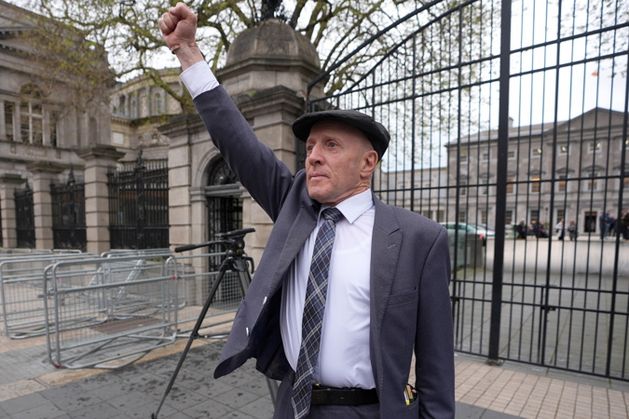
Ireland's government won its confidence vote 92-78 after junior agriculture minister Michael Healy-Rae resigned over the response to fuel protests, marking the first sustained political damage to the coalition since formation 15 months ago. The Dáil also approved a second fuel-relief package, including 10c/l diesel and petrol cuts, 24c/l support for green diesel, special haulage and agriculture schemes, and a delay to the planned carbon tax increase at a cost of €22m. The measures run until early July and reflect a broader effort to offset inflation and supply-chain pressure from fuel blockades.
This is less a policy surprise than a credibility event. The government likely preserves near-term arithmetic, but the resignation creates a second-order signal that the coalition’s backbench discipline is now contingent, not structural; that matters because every future flashpoint on energy, taxation, or public order becomes a test of command-and-control rather than a normal vote. The market implication is that legislative execution risk rises even if the cabinet survives, which usually compresses the odds of clean, multi-year reform and raises the chance of ad hoc fiscal concessions.
The larger winner is the protest ecosystem, not any single party. Once a government is seen responding with emergency price relief after visible disruption, the option value of street pressure increases: copycat action in transport, agriculture, and logistics becomes more attractive because the payoff is now demonstrably fiscal, not just symbolic. That creates a bad feedback loop for inflation management: temporary excise cuts can mute headline fuel CPI in the next print, but they also delay normalization and keep budget policy in reactive mode, which is mildly negative for the domestic rate narrative over the next 1-2 quarters.
The contrarian point is that the immediate fiscal cost is small relative to the signaling value. If the package really stabilizes supply chains and reduces blockade risk, the near-term benefit accrues to transport-heavy domestic cyclicals through lower disruption rather than through cheaper fuel per se. The bigger tail risk is not the vote itself, but an escalation in public-order rhetoric leading to overreach; any repeat of hardline enforcement or ministerial miscommunication could re-ignite protests within days and force another concession within weeks.
AI-powered research, real-time alerts, and portfolio analytics for institutional investors.
Request TrialOverall Sentiment
neutral
Sentiment Score
-0.08
