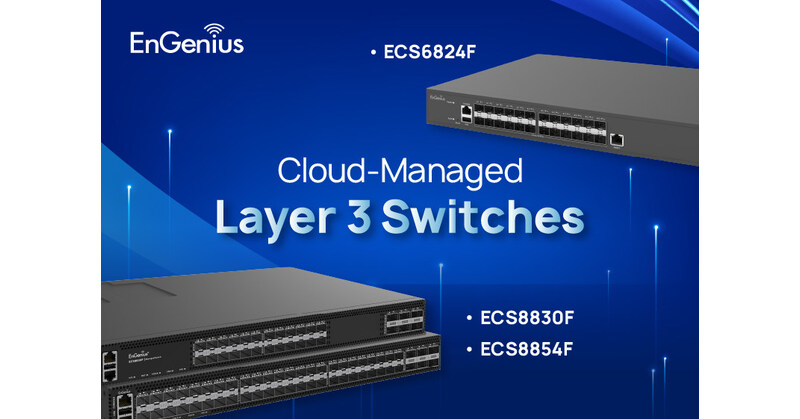
EnGenius launched a new cloud-managed Layer 3 switching lineup (ECS8830F, ECS8854F, ECS6824F) aimed at enterprise and SMB/MSP networks. The enterprise models offer up to 24×10G SFP+ plus 6×100G QSFP28 uplinks with switching capacity up to 1.68 Tbps (ECS8830F) and 2.16 Tbps (ECS8854F), alongside Layer 3 routing (OSPF/BGP/IS-IS) and resiliency features like MC-LAG/VSF and redundant hot-swappable power/fan modules. The 1U ECS6824F targets 10G core/branch use cases with 24×10G ports, 480 Gbps switching capacity, multicast support (IGMP/MLD), and security controls, paired with EnGenius Cloud for centralized visibility with local control via UI/CLI/SNMP/NETCONF.
This reads more like a channel-segmentation signal than a meaningful industry shock. The real mechanism is that cloud-managed, lower-ASP switching is getting good enough to pressure the mid-market where buyers care more about operational simplicity and bundle price than brand prestige; that is incremental margin risk for value-tier incumbents and a mild substitution threat to HPE Aruba, Extreme, and white-box OEMs in SMB/branch deployments. For Cisco, Arista, and Juniper, the impact is likely de minimis unless this product family starts showing up in larger channel wins or creates a visible ASP downshift in aggregation refresh cycles.
The second-order effect is on MSP control points: if EnGenius can pull more switching into its cloud stack, it increases vendor lock-in at the network-management layer and makes hardware replacement cheaper and more frequent for small customers. That could support recurring software-like attach over time, but only if adoption broadens beyond point-solution buyers; otherwise this is just portfolio housekeeping. Separately, 10G/100G migration in the edge is constructive for optics, transceiver, and cabling vendors, but that demand is already well telegraphed.
Time horizon matters: over days, this should not move public networking stocks; over 1-3 months, watch for channel commentary on SMB pricing pressure and whether enterprise buyers are trading down from premium vendors. Over 6-18 months, the falsifier is simple: if enterprise refresh spend remains driven by security, automation, and uptime rather than cost, low-end entrants will stay niche and pricing discipline across the group should hold.
AI-powered research, real-time alerts, and portfolio analytics for institutional investors.
Request TrialOverall Sentiment
mildly positive
Sentiment Score
0.12
