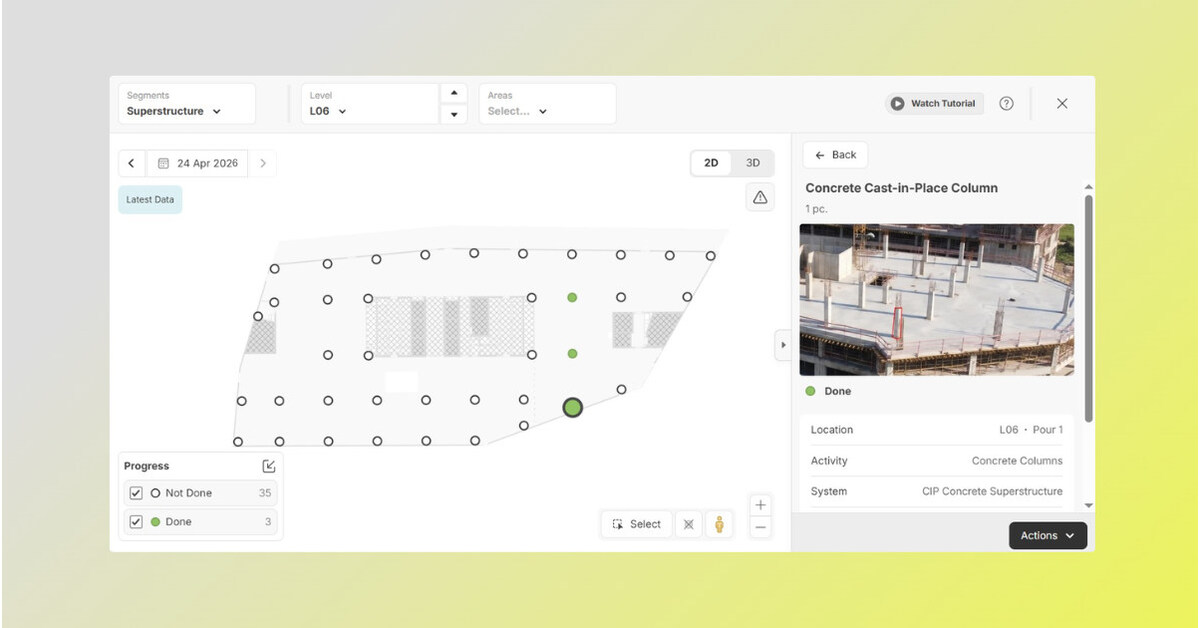
Buildots launched automated superstructure tracking to address gaps from manual floor-walking, using drones/360° cameras and AI to convert imagery into structured BIM-linked data. The product aims to catch structural delays weeks earlier with predictive risk analytics and production/cycle-time reporting, improving accountability for trades. Impact is largely company/product-specific rather than macro, and the article does not provide financial figures or guidance.
This is fundamentally a margin-variance story, not a revenue story. The economic payoff from better superstructure visibility is fewer schedule slips, less rework, and stronger claim-management — which matters most on large, latency-sensitive builds where one missed trade window can cascade into weeks of delay. That should be mildly positive for large contractors and owners with heavy capex pipelines, but the equity impact is second-order unless it shows up as fewer project write-downs or lower contingency reserves.
The bigger implication is bargaining power. If objective progress data becomes more ubiquitous, owners can push harder on liquidated damages, and GCs/subs lose the ambiguity that historically helped absorb slippage. Over 6-18 months, that can compress margins for weaker operators while favoring firms with stronger execution discipline and data-rich workflows. For BOUYY and HOCFF, the benefit is lower execution risk on complex projects; for INTC, it is more about protecting timing on data-center and fabrication-related capex than about any direct P&L uplift.
Contrarian take: the market may overrate near-term monetization because construction tech savings are mostly avoided losses, not visible upside. The real signal to watch is whether customers report tighter cycle-time variance and fewer schedule-driven charges in upcoming quarters; absent that, this remains a workflow enhancement rather than an earnings driver. If project volumes soften, adoption could still continue, but budget scrutiny would slow expansion into non-critical sites.
AI-powered research, real-time alerts, and portfolio analytics for institutional investors.
Overall Sentiment
mildly positive
Sentiment Score
0.12
Ticker Sentiment
