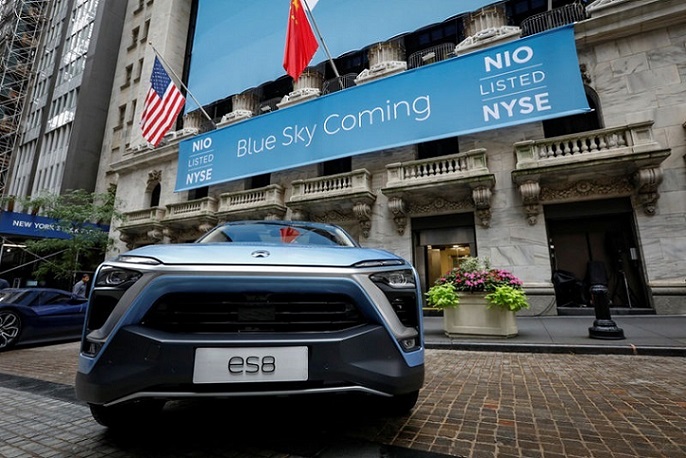
NIO reported Q4 2025 revenue of RMB34.7 billion, up 76% YoY and 59% QoQ, and delivered non-GAAP net profit of RMB728 million (vs a RMB6.5 billion loss YoY), while gross margin rose to 17.5% but missed BofA's 18.5% expectation and vehicle margin came in at 18.1% (vs 19.5% est). Q4 deliveries hit the high end of 125,000-unit guidance with 44% QoQ volume growth; founder forecasts 40–50% CAGR to 456–489k units by 2026 supported by new models. Analysts reacted with mixed upgrades/ratings: BofA raised its PT to $6.70 (Neutral), Macquarie upgraded to Outperform with a $6.10 PT, and Morgan Stanley reiterated Overweight with a $7.00 PT.
The market is treating the recent profitability print as directional confirmation rather than proof of a structural margin turn; that makes short-term sentiment fragile and long-term value contingent on repeatable margin drivers (ASP mix, battery cost decline, and software/recurring revenue cadence). If those drivers are execution-dependent, a single quarter of net income can be reversed quickly by incentive competition or an uptick in commodity/chip costs, so watch gross-margin components and equity investment P&L as early detectors of sustainability.
Second-order beneficiaries from a durable volume ramp are battery and powertrain suppliers, monetizable software ecosystems, and captive-finance/leasing arms that scale with used-car velocity; conversely, independent parts suppliers with limited pricing power and lower-ASP competitors will feel margin pressure and may accelerate discounting. Expect OEM competitors and regional dealers to react within 1–2 quarters — either by matching product mix and price or by carving out channel incentives that compress industry margins.
Key catalysts over three time bands: days — post-earnings sentiment and options-driven flows; months — new model deliveries and any announced changes to battery-sourcing or verticalization; 12–24 months — whether unit economics reach a self‑funding inflection that meaningfully reduces equity investment losses. Tail risks include a China demand shock, raw-material inflation, or materialized JV/equity impairments; any of these would flip the narrative swiftly and compress multiples even if headline volume growth continues.
AI-powered research, real-time alerts, and portfolio analytics for institutional investors.
Request DemoOverall Sentiment
mildly positive
Sentiment Score
0.30
Ticker Sentiment
