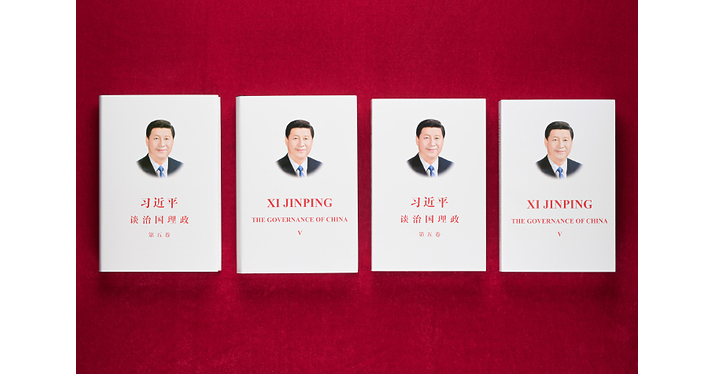
The article profiles the fifth volume of Xi Jinping’s “The Governance of China,” covering speeches/writings from May 27, 2022 to Dec. 20, 2024. It argues China’s governance model is a dialectical, iterative process that maintains markets as essential for efficiency/innovation while the state enables conditions via infrastructure, industrial policy, regulation, and public goods. It also rejects claims that China has abandoned the market or fully centralized decision-making, emphasizing local experimentation and feedback loops.
This reads as messaging, not a measurable policy shift. The investable question is whether Beijing is trying to lower the market’s “policy uncertainty discount” for domestic equities and ADRs, but rhetoric alone rarely moves earnings estimates unless it is followed by credit easing, regulatory reversals, or procurement changes. In the next 1-3 weeks, any response in China beta is more likely to be sentiment-driven than fundamentals-driven, so fades should work if no concrete follow-through appears.
Relative winners, if the framing sticks, are state-capital-intensive sectors: banks, insurers, telecoms, utilities, construction machinery, and select SOEs with implicit balance-sheet support. The second-order loser is the high-multiple private platform complex, because investors may infer “markets are important” yet still not get the unambiguous, capital-allocation-friendly reforms that would re-rate internet and consumer internet names. A more nuanced beneficiary is the domestic industrial supply chain tied to infrastructure and green capex, where policy consistency matters more than ideology.
The contrarian miss is that this kind of publication can actually signal confidence in current policy, not easing of it. If the next 1-3 months bring no lift in private capex, no improvement in credit impulse, and no reduction in regulatory ambiguity, this should fade into background noise. The structural bull case would require observable evidence that private-sector margins and funding access are improving; absent that, the right trade is relative, not directional, and probably short-duration.
AI-powered research, real-time alerts, and portfolio analytics for institutional investors.
Overall Sentiment
neutral
Sentiment Score
0.00
Ticker Sentiment
