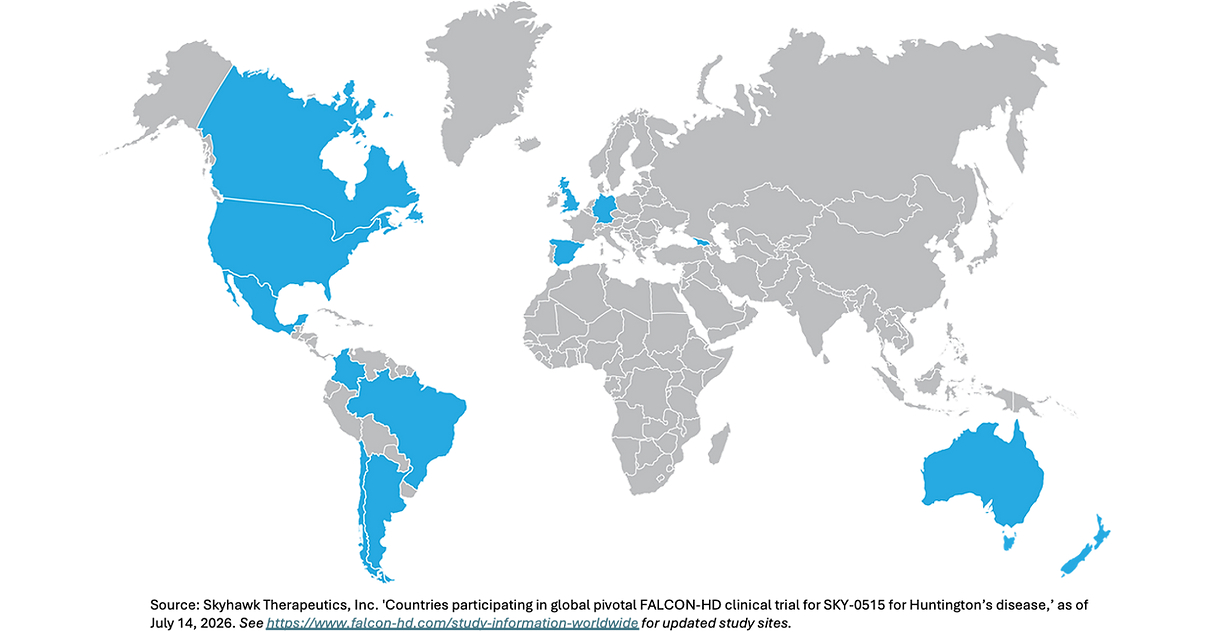
Skyhawk Therapeutics recibió aprobaciones regulatorias adicionales (aceptación IND en EE. UU. y aprobaciones CTA en Canadá y Reino Unido) para expandir su ensayo fundamental FALCON-HD fase 2/3 de SKY-0515. El ensayo ya cuenta con >175 pacientes inscritos en más de 20 sitios y, con la inscripción de Fase 1/2 completada, reporta reducciones de 69% en mHTT y 26% en PMS1, con mejoras en cUHDRS respecto a la historia natural. La compañía inicia/avanza reclutamiento en EE. UU., Canadá y Reino Unido con el objetivo de acelerar el desarrollo de una terapia oral “una pastilla al día”.
The immediate market read-through is less about Skyhawk itself than about the competitive discount rate on Huntington’s disease pipelines. An oral CNS small molecule with biomarker and early functional signal, if replicated in blinded data, would be structurally worse for intrathecal ASO and gene-therapy narratives because it lowers administration friction, manufacturing complexity, and long-term adherence risk. That said, this is still a biomarker-heavy story until placebo-adjusted slope data arrive; the biggest mistake would be capitalizing a “disease-modifying” franchise before the randomized phase 2/3 readout is in hand.
The second-order winner is the broader RNA-modulation platform: any validated efficacy in a hard CNS indication should improve partnering odds and financing terms for similar small-cap neurogenetic platforms. The losers are the HD names where valuation depends on scarce, high-durability clinical differentiation; if SKY-0515 keeps progressing, the market may start discounting future commercial share for programs that require higher-burden delivery or show narrower patient convenience. The short-term reaction could be overdone if investors extrapolate a non-randomized functional trend into peak sales rather than treating it as a de-risking step.
Catalyst path matters: over days, this is a sentiment event; over 1-3 months, the key is enrollment pace and whether additional geographies support a clean blinded dataset; over 6-18 months, the decisive variable is placebo-adjusted cUHDRS and safety durability. Falsifiers are any emerging hepatic/CNS tolerability issue, slower-than-expected recruitment, or a readout that shows biomarker suppression without functional separation from placebo. The contrarian view is that the market may be underestimating how much HD physicians will still prefer proven delivery and overestimating how quickly a small molecule can convert biomarker novelty into a standard-of-care franchise.
AI-powered research, real-time alerts, and portfolio analytics for institutional investors.
Request TrialOverall Sentiment
moderately positive
Sentiment Score
0.55
