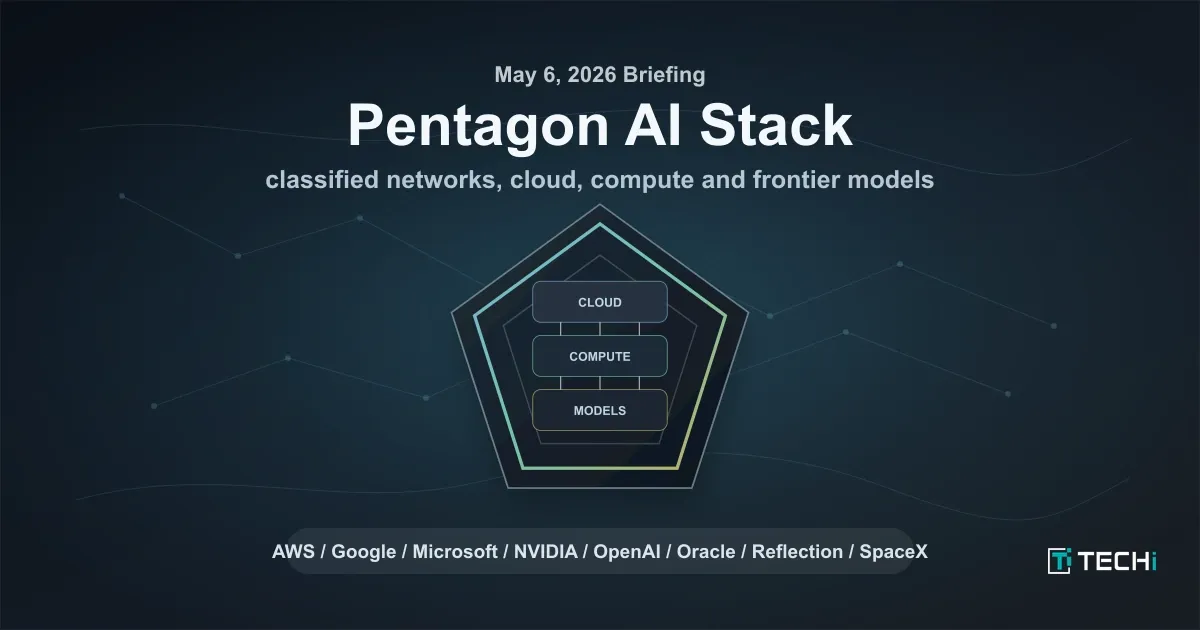
The Pentagon’s May 1 classified-network AI roster now includes 8 companies — SpaceX, OpenAI, Google, NVIDIA, Reflection, Microsoft, AWS and Oracle — signaling a layered AI stack for IL6/IL7 military environments rather than a single-vendor solution. The announcement is strategically positive for AI infrastructure and defense-tech exposure, but it discloses no contract values or revenue timing, so near-term financial impact is limited. NIST also added frontier-model testing agreements with Google DeepMind, Microsoft and xAI, reinforcing a broader government push to deploy and evaluate AI in national-security workflows.
This is less a procurement headline than a signal that the U.S. government is standardizing a two-sided market for defense AI: frontier models on one side, controlled cloud/compute and evaluation on the other. That structure should favor the largest infrastructure toll collectors first, because the hardest part of defense AI is not model quality but certification, isolation, uptime, and integration into classified workflows. In practice that keeps the monetization path concentrated in the picks-and-shovels layer while smaller model vendors get strategic credibility but slower revenue conversion.
The second-order beneficiary is NVIDIA. Once classified deployments move beyond pilots, inference economics matter more than benchmark marketing, and government buyers tend to over-index on reproducibility, hardware support, and secure runtime stacks. That creates a multi-quarter demand tail for enterprise AI software plus accelerated systems, but the bigger upside is indirect: every additional “approved” defense workflow expands installed base stickiness across clouds and GPUs, making displacement harder even if contract dollars are initially small.
The main risk is that the market extrapolates too much from symbolic inclusion. These are not yet revenue-dense awards, and defense adoption cycles can stretch 6-18 months before meaningful spend shows up. The more meaningful catalyst is NIST-style testing becoming institutionalized; if classified evaluation becomes a gating step, vendors with the best compliance posture can win outsized share even without the best model. Conversely, any incident around hallucinations, data leakage, or misuse could slow procurement and compress the current optimism premium.
Consensus is probably underestimating Oracle’s relative position and overestimating the near-term benefit to pure model names. Oracle’s government-cloud credibility makes it a plausible share gainer if the Pentagon wants diversity away from the obvious hyperscaler duopoly, while OpenAI’s and Anthropic’s economics remain more policy-sensitive and less directly monetizable. The trade is therefore not “AI good,” but “secure AI infrastructure gets paid first, models later.”
AI-powered research, real-time alerts, and portfolio analytics for institutional investors.
Request DemoOverall Sentiment
mildly positive
Sentiment Score
0.25
Ticker Sentiment
