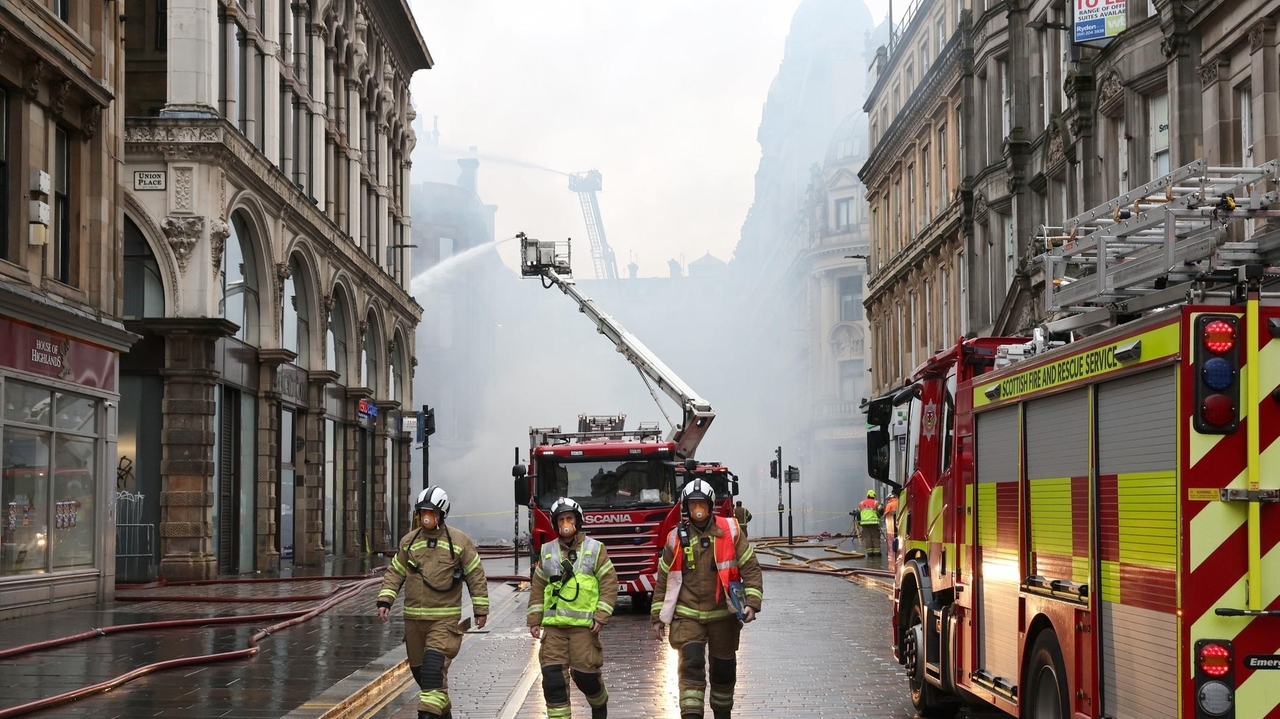
A fire destroyed a four-story building next to Glasgow Central Station, forcing closure of Scotland's busiest rail hub and disrupting all travel to, from and through the station with no estimated reopening time. The 1851-era building collapsed leaving only the facade; a cafe, a fish-and-chip shop and a hair salon were among businesses wrecked. There were no injuries reported, but rail service disruption and local business losses create near-term operational and economic impacts for the area.
A sudden, localized outage of a major urban transport node produces outsized redistribution effects across modes and local commerce. Expect 30–50% of displaced passengers to shift to surface modes within 72 hours, creating transient demand spikes for coach/bus charters and taxi fleets and raising last‑mile delivery costs from higher congestion — these effects decay over 2–8 weeks as timetables and alternative routing are restored.
Adjacent retail and service businesses will see concentrated revenue losses that are not linear: footfall-dependent tenants typically experience 40–70% weekly sales declines in the immediate aftermath, with cashflow stress leading some small tenants to exit within 1–3 months. Insurance and reinstatement workflows mean cash settlements and rebuild payments are spread over 6–24 months, but materials and contractor demand is front‑loaded into the first 3–12 months once insurers approve scopes.
For transport operators and infrastructure owners, the political catalyst is regulatory scrutiny and a renewed capex cycle for resilience (platform access, fire suppression, heritage-safe materials). That implies a multi‑year uplift in maintenance and specialist restoration spend, concentrated among materials suppliers and firms with heritage/stonework capabilities, while undercapitalized local retail REITs and microbusinesses carry kinked cashflow risk.
Watch for three near-term reversible catalysts: (1) rapid deployment of substitute bus capacity (reduces revenue tail), (2) insurance reserve adjustments or meaningful provisioning (reveals net economic hit), and (3) public funding for restoration versus private rebuilds (determines contractor winner set). Each catalyst has distinct time constants: days for modal shifts, weeks–months for retail distress, and 6–36 months for reconstruction spend to flow through P&Ls.
AI-powered research, real-time alerts, and portfolio analytics for institutional investors.
Request DemoOverall Sentiment
mildly negative
Sentiment Score
-0.30
