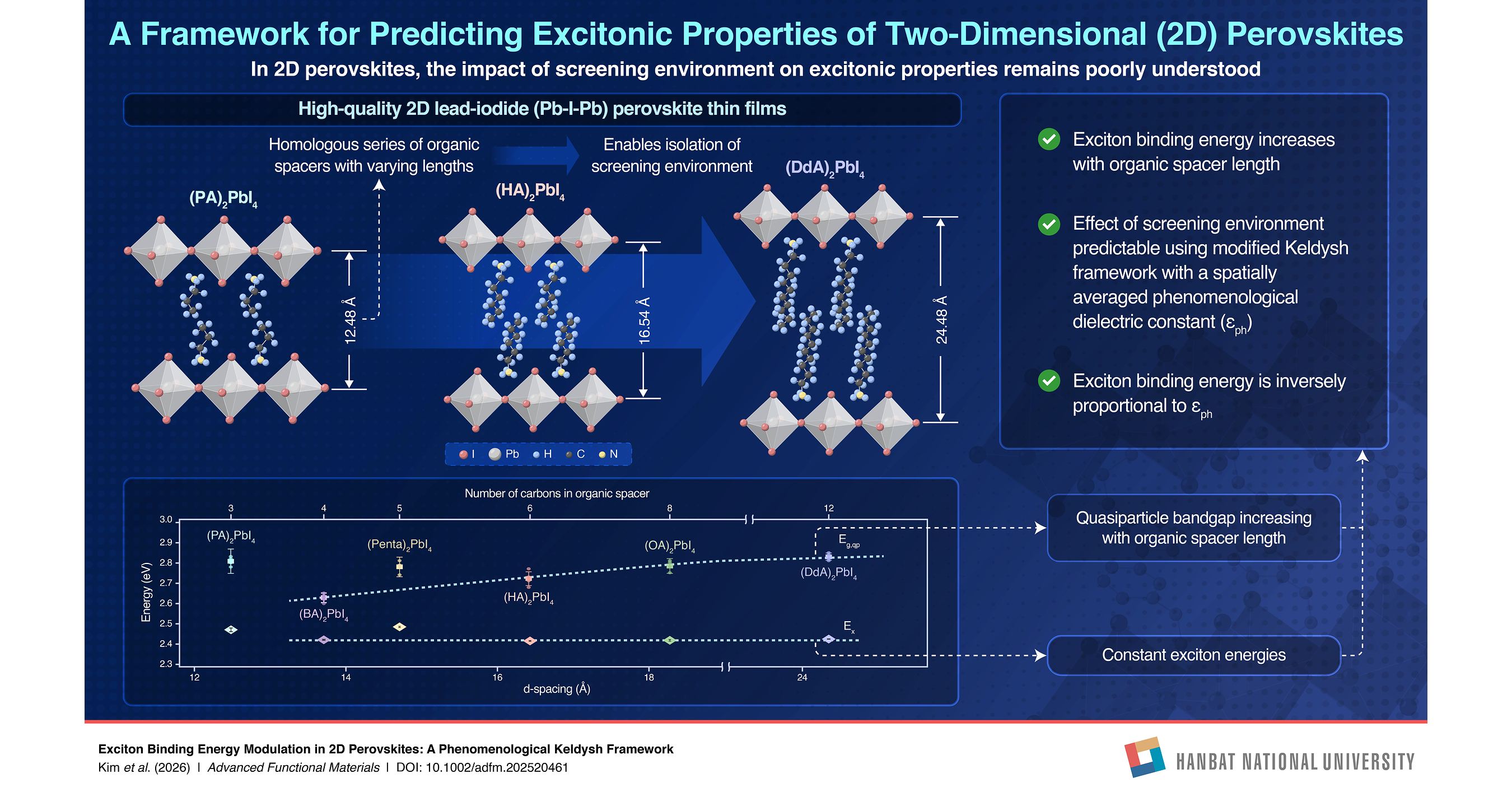
Hanbat National University researchers unveiled a predictive model for tuning exciton properties in 2D perovskites by separating dielectric-screening effects from structural distortion. In experiments with high-quality 2D lead-iodide perovskite thin films, increasing organic spacer length widened the quasiparticle bandgap while keeping exciton energy nearly constant, driving higher exciton binding energy and enabling improved modeling via a phenomenological dielectric function. The work (Advanced Functional Materials, published April 13, 2026) provides practical design rules that could accelerate more stable, tunable optoelectronic technologies.
This is a de-risking event for the science, not yet for the cash flows. The meaningful shift is that the bottleneck moves from “can these materials be modeled?” toward “can anyone manufacture them reproducibly at scale,” which tends to favor capital-rich incumbents with pilot lines and process control over small lab-stage developers. In the near term, the market should not pay up for revenue; the value is in optionality around faster iteration, better yield learning, and stronger IP around spacer engineering.
The second-order winners are the picks-and-shovels names tied to thin-film deposition, metrology, and encapsulation, because any commercialization path needs tighter process windows. The losers, if this thesis compounds over 6-18 months, are legacy PV and display technologies whose pricing power erodes once perovskite tandems or emissive layers become more bankable. But that transition is gated by stability, defect control, and regulatory comfort on lead handling—issues this result does not solve.
Consensus is likely overestimating how quickly a better exciton model translates into a product. The market tends to confuse scientific elegance with commercial readiness; the falsifier is a lack of partner validation, outdoor stability data, or pilot-line yield improvement over the next 1-2 quarters. Until then, this reads as a research positive with low immediate tradability.
AI-powered research, real-time alerts, and portfolio analytics for institutional investors.
Overall Sentiment
mildly positive
Sentiment Score
0.15
