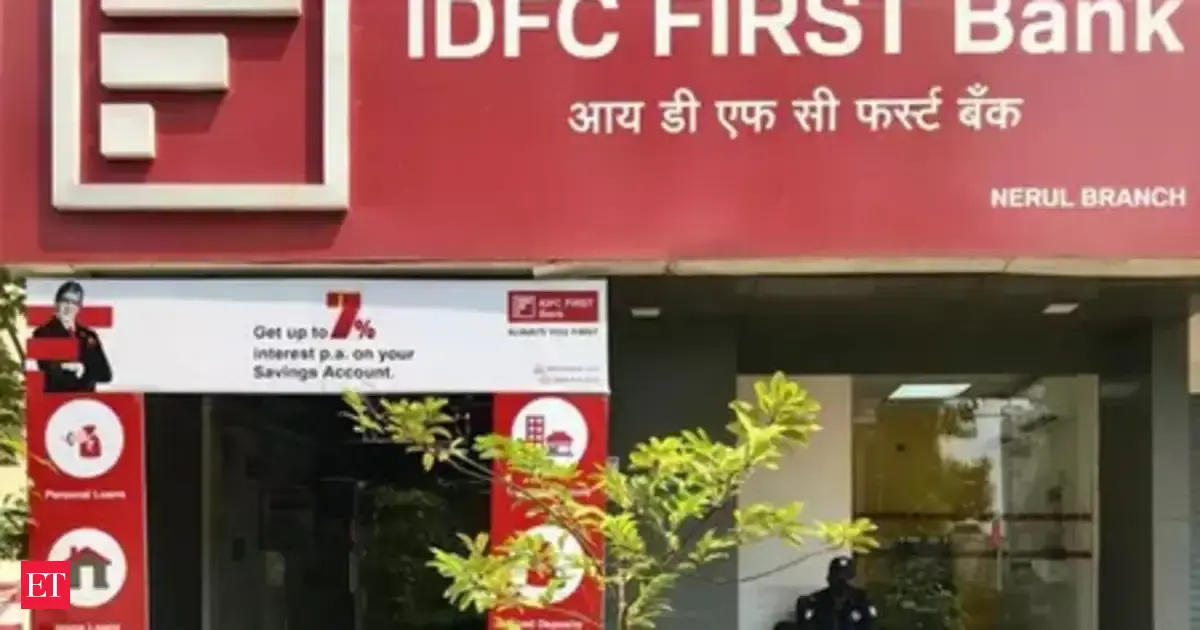
IDFC First Bank disclosed suspected unauthorised activity concentrated in a Chandigarh branch affecting primarily Haryana government accounts, with reconciliation gaps estimated at about ₹590 crore. The bank has suspended four employees, initiated disciplinary, civil and criminal proceedings, appointed KPMG for a forensic audit, and is seeking recovery via liens and legal action; management maintains the issue is isolated and the bank is well-capitalised. The revelation wiped roughly ₹14,438 crore of market value as shares plunged as much as 20%, a loss material relative to the bank’s December-quarter net profit of ₹503 crore, and broker estimates suggest a ~20–22% hit to FY26 profits before/after tax depending on assumptions. Final losses remain uncertain and will hinge on claim validation, recoveries and legal outcomes.
Market structure: The immediate losers are IDFC First Bank (IDFCFIRSTB) and similar mid‑tier banks with concentrated government deposit books (AU Small Finance Bank), as government re-routing and reputational loss can shift tens‑to‑hundreds of crores of low‑cost deposits to larger banks. Winners are large, well‑capitalised private banks (HDFC Bank, ICICI Bank) that will likely capture displaced government business and see marginally cheaper funding; broker volatility providers and forensic/accounting firms (KPMG) also benefit. Cross‑asset: expect bank equity IV to spike short‑term, a modest flight‑to‑quality into sovereigns cutting near‑term yields, and a small INR depreciation pressure if sentiment deteriorates across regional banks. Risk assessment: Tail risks include regulatory clampdowns (RBI deposit restrictions, heavier capital overlays) or discovery of wider branch‑level collusion that pushes losses beyond the reported ~₹590 crore; low‑probability but high‑impact scenario: loss >₹2,000 crore or RBI‑ordered restrictions leading to contagion across small banks. Time horizons: days — heightened volatility and liquidity squeezes; weeks/months — KPMG forensic, lien recoveries and police/criminal outcomes; 6–12 months — potential regulatory changes affecting pricing and capital. Hidden dependencies: third‑party vendor access and reconciliation systems, government treasury tech stack, and state governments’ speed in re‑allocating balances. Trade implications: Short IDFCFIRSTB/AU SFB exposure near term and rotate into HDFC Bank/ICICI Bank as quality longs; implement options hedges (3‑month put or put‑spread on IDFCFIRSTB and 1‑month bank index puts) to buy convex protection. Pair trades (long HDFCBANK, short IDFCFIRSTB) exploit flight‑to‑quality and should be sized small (2–4% notional) given audit uncertainty. Entry windows: establish hedges within 48–72 hours, increase if forensic output is delayed beyond 30 days or market cap loss exceeds 20%. Contrarian angles: Consensus prices a near‑permanent hit equal to the full ₹590 crore; historically recoveries from traceable downstream accounts often recover 40–70% within 3–6 months — if KPMG secures >60% recovery within 90 days, the sell‑off will be overdone and presents a tactical long entry. Conversely, RBI fines/capital hits >₹500–800 crore or evidence of systemic control failures justify deepening shorts. Watch three triggers: % recovered of disputed ₹590cr, number/value of liens placed, and RBI disciplinary action — use these to scale positions within 30/90/180 day bands.
AI-powered research, real-time alerts, and portfolio analytics for institutional investors.
Request DemoOverall Sentiment
strongly negative
Sentiment Score
-0.62
Ticker Sentiment
