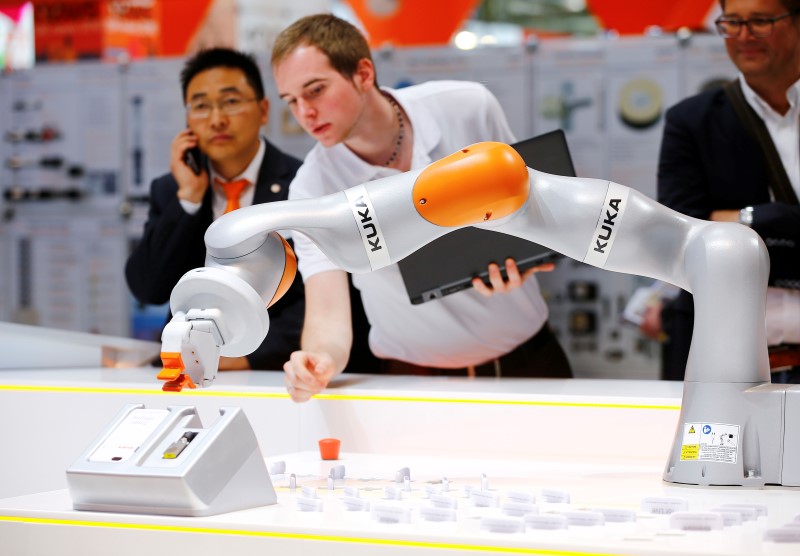
China has built a dominant position in the physical manufacturing and deployment layer of AI robotics, with more than 295,000 annual industrial robot installations versus 34,200 in the U.S. The report says China supplies 80% to 90% of key hardware components globally, controls 93% of the permanent magnet market, and processes nearly 99% of heavy rare earths needed for robotic motors. The piece highlights a bifurcated AI landscape: the U.S. leads in frontier silicon and software, while China is compounding cost and scale advantages in embodied intelligence and robotics deployment.
The market should treat this less as a generic AI headline and more as a relative-value signal inside the robotics stack: China’s edge is in turning robotics into a manufacturing flywheel, while the U.S. edge remains concentrated in upstream compute. That means the near-term earnings leverage likely sits with companies exposed to volume expansion, components, integration, and industrial automation rather than pure frontier AI software. The second-order winner is whichever suppliers can monetize a higher installed base and faster replacement cycle; the loser is any OEM relying on scarcity pricing or imported subassemblies with weak bargaining power.
The strategic risk is that the U.S. robotics thesis is too dependent on simulation and silicon while still bottlenecked by Asian component supply, which creates an asymmetry: even if U.S. models stay ahead technologically, scaling them economically may lag by 12-24 months. That gap matters because robotics is a deployment game; if China keeps compressing unit costs and expanding real-world operating hours, it can lock in standards, service ecosystems, and data advantages before Western incumbents can respond. For markets, that favors industrial electrification, motion-control, sensors, magnet alternatives, and domestic supply-chain reshoring names over pure-play humanoid hype.
Consensus may be underestimating how deflationary this is for the hardware layer. Lower robot prices are not just good for adoption; they pressure margins across integrators, force faster capex payback assumptions, and can trigger a winner-take-most procurement cycle in the next 6-18 months. The contrarian risk is that investors overpay for the obvious “AI winner” names while missing that the bottleneck is moving from model quality to factory throughput and materials access.
A separate catalyst path is policy: any meaningful tariff reduction or trade thaw would mainly help U.S. firms that still depend on Chinese-made subcomponents, but it could also accelerate Chinese exports of robotics hardware into third markets. That would be bearish for niche Western automation vendors without scale and bullish for ecosystem leaders with pricing power, balance sheet strength, and global service networks.
AI-powered research, real-time alerts, and portfolio analytics for institutional investors.
Request DemoOverall Sentiment
neutral
Sentiment Score
0.15
Ticker Sentiment
