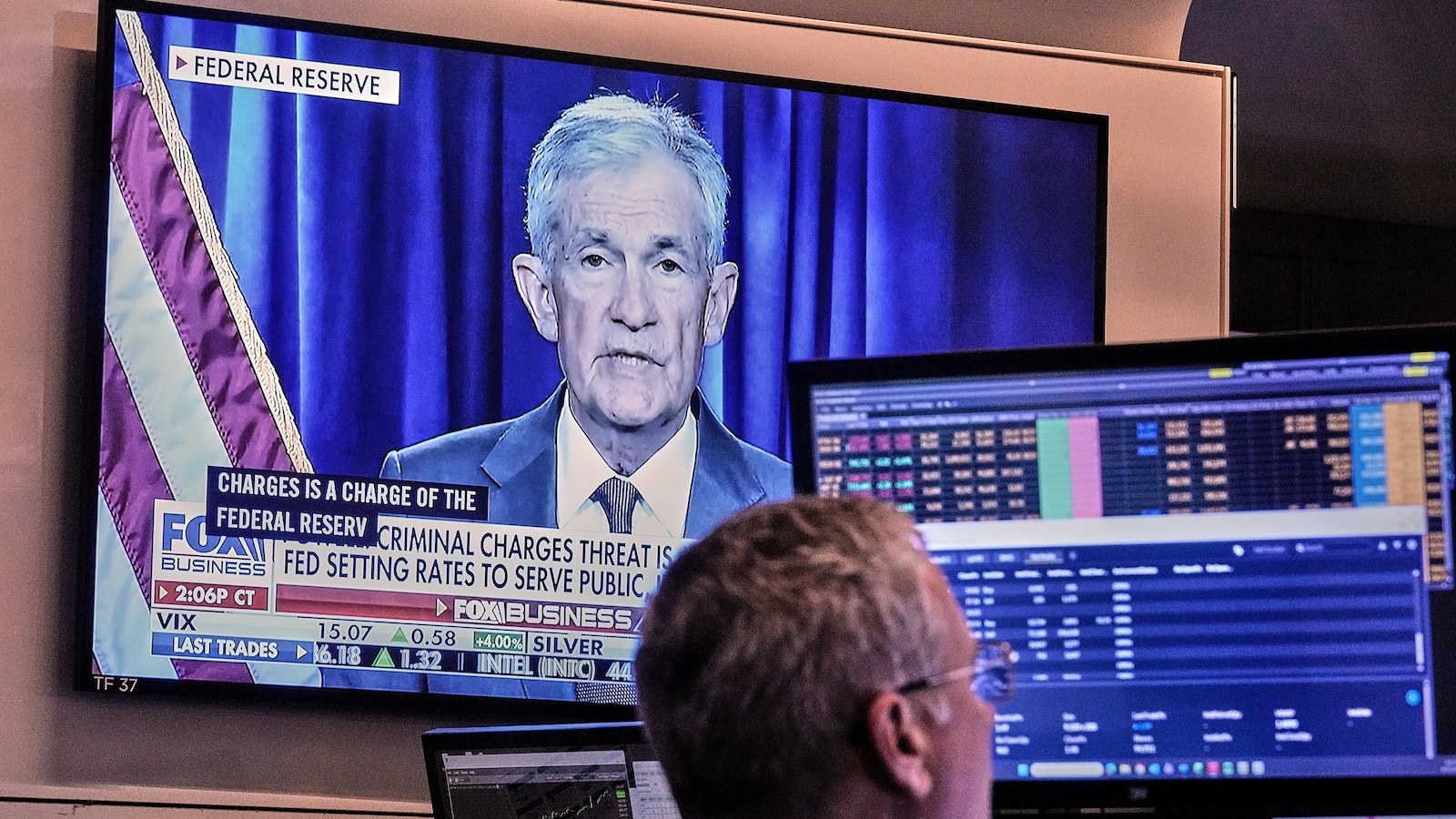
The Federal Reserve is widely expected to hold its key short-term rate near 3.6% at this week's meeting after three 25bp cuts last year, with officials emphasizing decisions will be driven by economics amid elevated inflation (PCE-like measure up 2.8% year-over-year in November) and a still-stable labor market. The meeting is occurring under the cloud of a DOJ subpoena into Chair Powell’s testimony over a $2.5bn building renovation and related political pressure from the White House, but Fed officials and economists expect the policy process to proceed normally; markets price roughly two quarter-point cuts this year if inflation moderates and hiring weakens. Economic upside risks include possible stronger growth from higher tax refunds (estimated ~20% higher, ~$3,500 average) and solid Q3 GDP (4.4% annualized), which could delay further rate cuts.
Market structure: keeping the fed funds rate at ~3.6% while markets price two 25bp cuts to ~3.1% by year-end favors banks, money-market funds and short-duration credit (higher NIM, deposit repricing), and hurts long-duration assets (TLT, growth tech) and housing-sensitive names (DHI, PHM, mortgage originators). Expect modest USD firmness near-term and steeper response in 2y yields to Fed guidance; commodities and gold will trade on inflation prints (core PCE 2.6–3.2% range is decisive). Risk assessment: low‑probability high‑impact tail risks include escalation of DOJ/Subpoena or removal of governors that could spike risk premia and widen credit spreads >50bps in days; key thresholds—core PCE >3.0% next two months likely delays cuts, unemployment rising above ~4.5% materially increases cut probability. Hidden dependency: a ~20% higher tax refund seasonally (estimated $3.5k avg) could lift consumption and mute recession risk, compressing chance of Fed easing. Trade implications: tactically favor short-duration rate exposure and financials vs long-duration growth. Specific plays that map to timing: a spring/summer play on Fed cuts (buy 2y futures/notes vs sell 10y futures to capture expected 2y outperformance), selective long bank exposure (JPM, BAC; 3–6 month horizon), and short TLT or buy inverse 20+yr ETF as a hedge against upside inflation prints. Contrarian angles: consensus of two cuts may be underpricing sticky labor/inflation — if core PCE stays >2.8% through Q2, yields could reprice higher and value outperforms; alternatively, political/legal shocks could create a short-lived safe‑haven rally (buy GLD, USTs) that will reverse once Fed reasserts independence. Historical parallel: markets have flipped rapidly when incoming data diverges from consensus Fed pricing; trade size and protective stops must assume 30–60 day regime shifts.
AI-powered research, real-time alerts, and portfolio analytics for institutional investors.
Request DemoOverall Sentiment
mixed
Sentiment Score
0.00
Ticker Sentiment
