


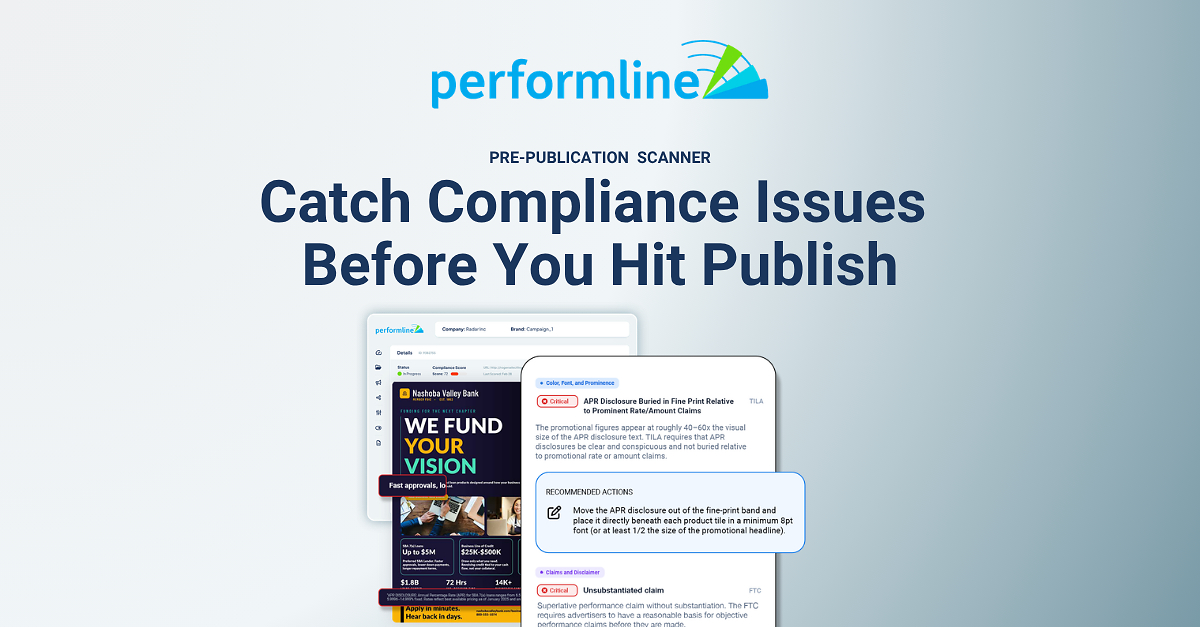
PerformLine launched Pre-Publication Scanner, an AI-based compliance review product that scores marketing assets (0–100) and flags regulatory/brand issues before publication, including image and disclosure checks. The system provides severity, regulatory basis, plain-language explanations, and suggested compliant rewrites in a single pass, aiming to reduce bottlenecks and downstream takedown/rework costs. The announcement is product-focused with limited evidence of immediate financial impact beyond potential efficiency/risk reduction for regulated institutions.
This is more of an adoption signal than a hard revenue event for the public names. The incremental winner is the workflow layer: if compliance checks move upstream into the creation process, the system-of-record tools used by marketers and reviewers can become stickier, which modestly favors ASAN and MNDY as embedded work-management surfaces. FIG is the weakest read-through because the value is in routing, approvals, and audit trails rather than design software itself.
The more durable effect is on compliance incumbents and manual-review labor, not on software multiples today. Over 1-3 months, the market may extrapolate "AI compliance" as a feature race, but the real monetization depends on false-positive rates, audit defensibility, and whether regulated customers actually shift spend from headcount to software. If the product reduces review cycle time, it can lift marketing throughput for banks/fintechs, but that is a second-order benefit to the regulated end customers, not necessarily a near-term ARR step-up for the public SaaS names mentioned here.
Contrarian view: the consensus may overestimate how quickly generic AI can replace compliance judgment. In regulated workflows, liability usually increases adoption friction; buyers will test the tool, but procurement will hinge on explainability, jurisdictional coverage, and integration depth. That means the stock market may be too quick to price a broad AI uplift for adjacent SaaS, while the actual upside is likely small and delayed unless these platforms can prove measurable retention or expansion within existing enterprise accounts.
Key risk is competitive substitution: if this functionality migrates into Microsoft, Adobe, or GRC suites, point solutions and workflow vendors could lose pricing power. Falsifiers to watch are not the launch itself, but customer proof points: added module revenue, higher attach rates, or a meaningful change in enterprise workflow share over the next 2-4 quarters. Absent that, this is mostly a product-news catalyst, not a thesis changer.
AI-powered research, real-time alerts, and portfolio analytics for institutional investors.
Request TrialOverall Sentiment
mildly positive
Sentiment Score
0.15
Ticker Sentiment
