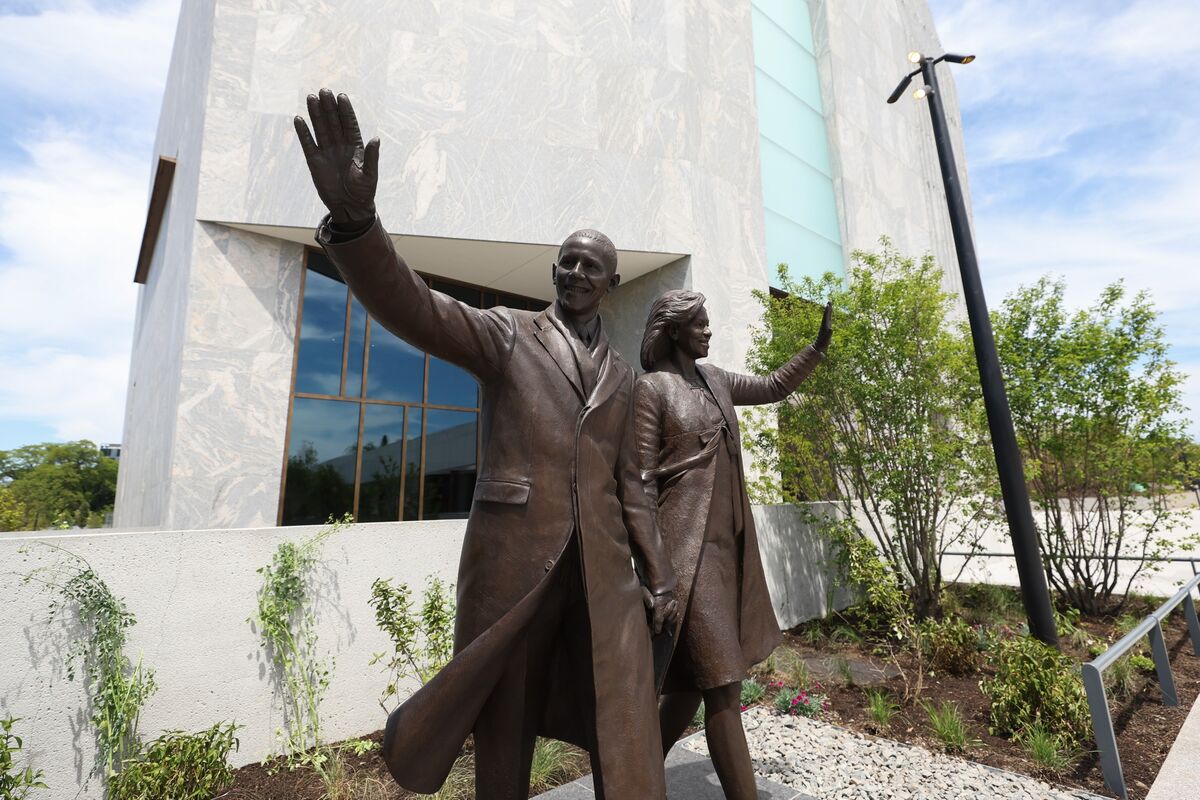
Barack Obama's $850 million presidential center opens amid a politically charged backdrop as the 44th president returns to the public stage with his party facing critical midterms. The article frames the center as both a legacy project and a symbol of the backlash against his agenda and broader diversity initiatives. Market impact is minimal, with the piece centered on domestic politics rather than financial or corporate developments.
The market implication is not about the center itself; it is about narrative timing. A high-visibility legacy event for the most symbolically important Democratic president can briefly tighten intra-party alignment and improve the odds of cleaner messaging into the midterms, which tends to matter more for sector rotation than for broad index direction. The near-term beneficiaries are contractors, donors, and adjacent civic/education vendors tied to the event ecosystem; the larger second-order effect is a potential uplift in the political durability of public spending and DEI-adjacent procurement if the opening becomes a fundraising and organizing focal point.
The risk is that symbolism cuts both ways. If the opening is read as a retrospective capstone rather than a forward-looking agenda reset, it may underscore how much of the prior policy architecture is now vulnerable, which can deepen cynicism among moderates and donors over a 1-3 month horizon. That would be negative for firms with high exposure to federal grant dependence, ESG-branded consulting, and university/NGO service providers whose budgets are sensitive to political backlash cycles.
Contrarian read: the consensus may be underestimating how little direct economic signal this has, and overtrading the headline. In the absence of a concrete legislative catalyst, the strongest trade is likely in volatility around policy-sensitive baskets rather than outright direction. The event is more useful as a sentiment checkpoint than as a durable macro inflection point unless it coincides with polling-driven shifts in congressional control over the next 6-10 weeks.
AI-powered research, real-time alerts, and portfolio analytics for institutional investors.
Request DemoOverall Sentiment
neutral
Sentiment Score
-0.05
