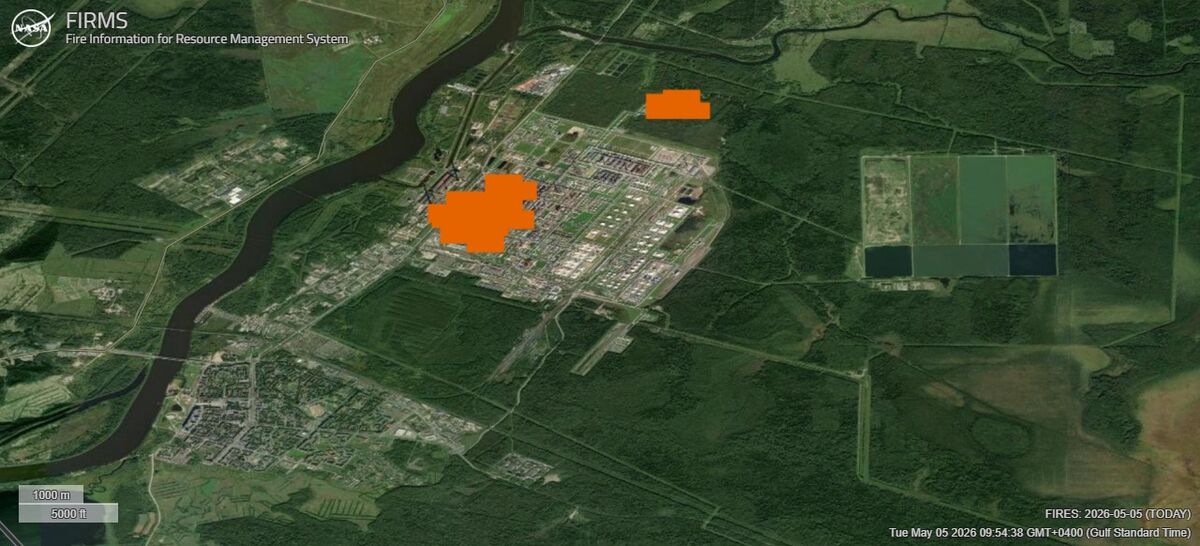
Russia’s Kirishi oil refinery was reportedly on fire after overnight drone strikes, with NASA satellite images detecting heating anomalies at the site and nearby areas. The attack underscores escalating wartime damage to Russian energy infrastructure as Ukraine intensifies strikes ahead of planned Victory Day ceasefires. The incident may heighten concern around regional fuel supply and broader geopolitical risk.
This is less about one refinery outage and more about the market repricing the fragility of regional product balance. Any sustained disruption to a major Russian conversion node tightens diesel and fuel-oil availability at the margin, which matters disproportionately because the marginal barrel in Europe is already being sourced with long logistics and thinner inventories. The second-order effect is not just higher crude volatility; it is a wider crack spread complex and a bid for refined products versus outright crude, especially if attacks force precautionary run cuts elsewhere.
The near-term winner is the physical option value embedded in non-Russian refiners with export access into Europe and the Atlantic Basin. Asian and Middle Eastern refiners can capture incremental margin if European buyers scramble for replacement molecules, while tanker rates may firm from longer voyage distances and more opportunistic shipping flows. The losers are Russian domestic fuel markets and any downstream industrial users dependent on stable local product supply, but the broader market risk is that these strikes push Moscow to harden infrastructure defense and retaliate asymmetrically, raising the probability of episodic energy infrastructure shocks over the next several weeks.
The key catalyst path is binary: either damage is contained and the move fades within days, or the market starts pricing a pattern of repeated refinery interruptions into late Q2/Q3 product balances. Because this is a geopolitical supply-risk event rather than a demand event, the most likely overreaction is in front-end implied vol and product cracks, not in long-dated crude. The contrarian miss is that headline risk can be overstated if inventories and spare refining capacity absorb the outage; that would mean the rally in energy complexity is tradable, but not necessarily durable.
For portfolio construction, this argues for a tactical long in refined-product exposure versus crude, with explicit risk control if repair timelines prove short. The trade should be sized as a volatility expression rather than a core macro call, since ceasefire optics can reverse sentiment quickly and the market may fade the move once satellite imagery stops updating. The broader theme is that infrastructure war increases the option value of assets with redundant capacity and insurance-like characteristics, while penalizing single-point downstream chokepoints.
AI-powered research, real-time alerts, and portfolio analytics for institutional investors.
Request DemoOverall Sentiment
moderately negative
Sentiment Score
-0.45
