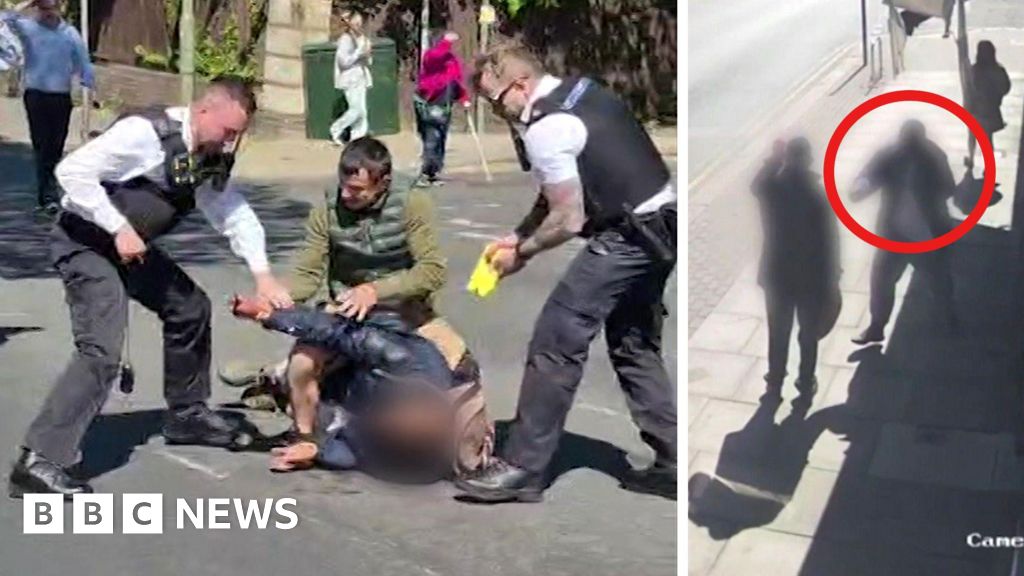
Two Jewish men were stabbed in Golders Green in what police declared a terrorist incident; both victims are in stable condition, while the suspect, a 45-year-old British national born in Somalia, was arrested on suspicion of attempted murder. Authorities said the attacker also tried to stab responding officers, prompting a counterterrorism investigation and a search linked to an earlier Southwark incident. The event has intensified political and community concern over antisemitism in the UK, with senior leaders calling for enhanced security and stronger action.
The immediate market read is not on direct listed exposure, but on the policy stack that usually follows an antisemitic terror event: higher public-security spend, tighter perimeter protection for schools/synagogues, and more intrusive surveillance/compliance budgets. That is a slow-burn tailwind for selected defense, electronic security, and critical-infrastructure names, with the first-order winner being vendors that sell recurring monitoring, access control, and incident-response systems rather than heavy platforms. The second-order effect is budget reallocation inside UK municipal and national spending, which can crowd out discretionary local capex over the next 2-4 quarters.
The more actionable market implication is an upward reset in perceived domestic unrest and political fragmentation risk in the UK. That tends to widen the discount rate on UK consumer-facing and transport assets at the margin, but the bigger impact is on organizations with concentrated urban footfall and soft security posture; insurance pricing, guard services, and event-security demand can rise quickly after incidents like this. In parallel, the government’s rhetoric about foreign-linked encouragement of violence raises the odds of sanctions, investigations, and digital-platform enforcement actions over coming months, which is bullish for cyber-monitoring and intelligence-adjacent contractors.
The contrarian point is that the event itself does not automatically justify a broad risk-off trade in UK equities or sterling; markets often overreact for a day and then mean-revert unless there is a repeat event, a copycat wave, or evidence of systemic security failure. The real catalyst to watch is whether this becomes a sustained domestic-security repricing with additional incidents over 2-6 weeks. If the political response is credible and visible, the premium can fade quickly; if not, expect a persistent bid for private security, defense technology, and infrastructure hardening names.
AI-powered research, real-time alerts, and portfolio analytics for institutional investors.
Request DemoOverall Sentiment
extremely negative
Sentiment Score
-0.86
Near-term, the best trade is to express the theme through beneficiaries of elevated security budgets rather than trying to short broad UK risk. The risk/reward is asymmetric if further incidents keep headlines elevated, but it is poor if policy response is swift and contained, so structure trades with defined downside and a 1-3 month horizon.
