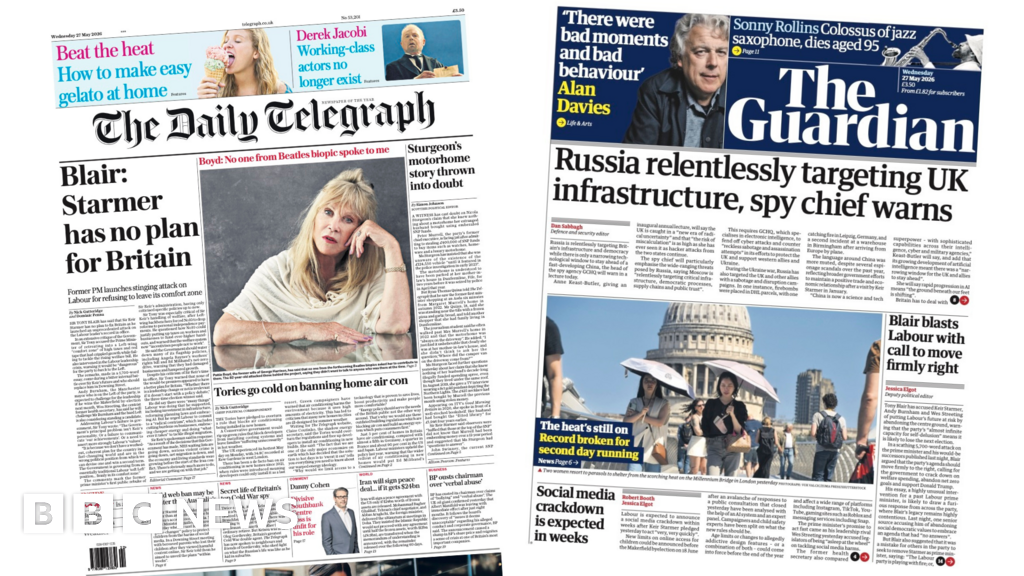
The article is a roundup of UK newspaper front pages centered on Sir Tony Blair's blistering criticism of the Labour government, as well as expected Labour action on social media restrictions for under-16s within weeks. It also notes commentary on a Court of Appeal referral in a Hampshire rape case and criticism of a water company over leak-related advice. The main market-relevant item is the prospect of tighter social media regulation, but the piece is largely political and opinion-driven rather than market-moving.
The market implication here is not the headline politics itself, but the growing probability of policy whiplash in UK consumer-facing sectors. A Labour leadership struggle or drift toward more overtly redistributive economics raises the odds of slower implementation, selective reversals, and noisier regulation across online platforms, utilities, and education/child-safety adjacent names. That tends to compress multiples for domestic UK-listed cyclicals and “policy beta” assets even if macro data stay unchanged, because investors price a wider distribution of future tax, pricing, and compliance outcomes.
The most tradable second-order effect is on social media and digital advertising risk: any crackdown focused on product features rather than a full ban still increases compliance cost, reduces engagement time, and creates precedent for broader age-gating or design constraints elsewhere in Europe. The near-term winner is likely legacy media and any platform with lower youth engagement exposure; the loser set is broader than the article implies because once one jurisdiction legitimizes feature-level restrictions, copycat measures become easier in other markets over the next 6-18 months.
On utilities, the water angle is less about reputational embarrassment and more about regulatory reset risk. Public anger around leakage and conservation messaging increases the probability of tougher capex targets, lower allowed returns, or mandated remediation spending, which is negative for leveraged water balance sheets and positive for contractors and leak-detection vendors. The tail risk is that politicians use visible service failures as a proxy for a wider anti-monopoly agenda, which would matter for other UK regulated assets as well.
Contrarian take: the market may be overestimating the durability of any immediate policy shift because intra-party conflict often delays rather than accelerates legislation. If leadership friction grows, the first-order effect can actually be paralysis, which is mildly bullish for incumbents and bearish for ambitious regulatory reformers. That argues for tactical rather than structural positioning until there is evidence of an enforceable policy package or a real leadership transition.
AI-powered research, real-time alerts, and portfolio analytics for institutional investors.
Request DemoOverall Sentiment
neutral
Sentiment Score
-0.10
