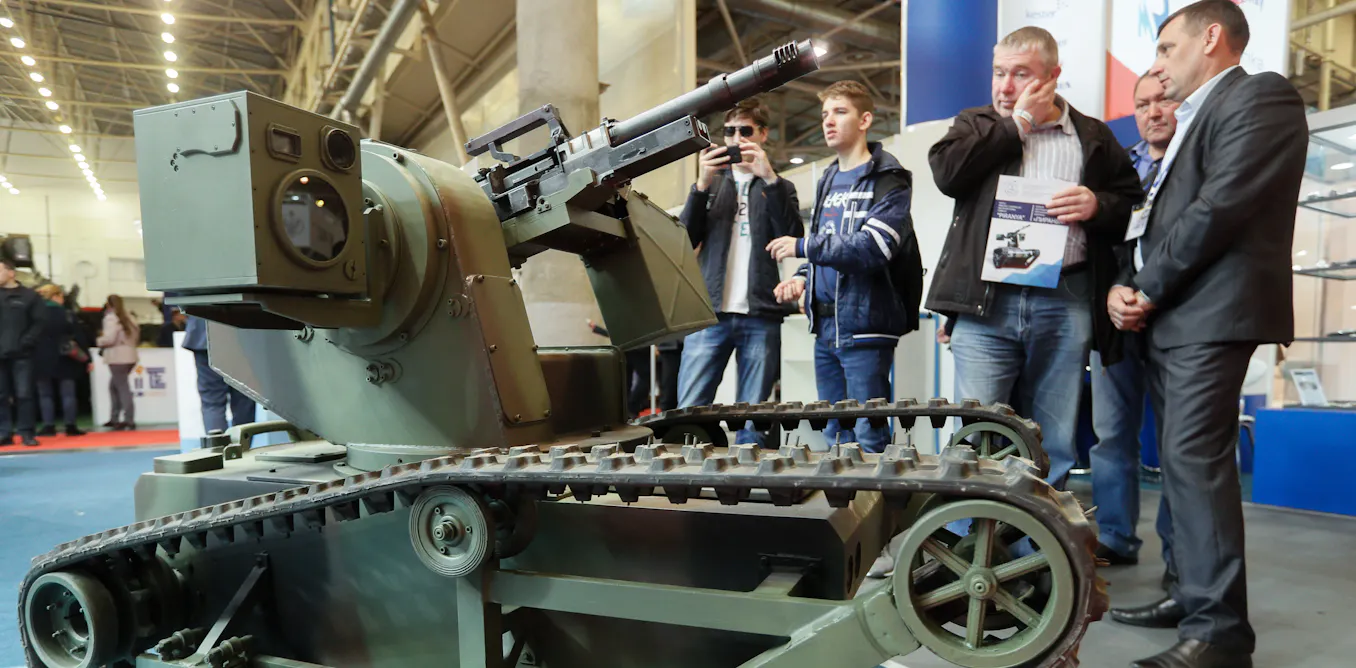
Ukraine said ground robots captured a Russian position for the first time in the war, highlighting a new battlefield use case for unmanned ground vehicles. The article frames this as a tactical milestone, but argues robots will remain mainly in support roles such as evacuation, resupply, engineering, mine laying, and mine clearing rather than replacing infantry. The broader implication is continued acceleration in defense robotics demand, especially for low-cost, remotely operated systems under high jamming and terrain constraints.
The investable signal is not “robots replace infantry,” but that attritable autonomy is moving from proof-of-concept to budget line. That shifts spend toward low-cost, mass-producible systems, sensors, comms hardening, EW-resistant navigation, and battlefield software rather than traditional manned platforms alone. The first-order beneficiary set is broader than prime contractors: niche autonomy, robotics, fiber optics, power management, thermal imaging, and secure mesh-network suppliers should see a pull-forward in demand as militaries prioritize replaceable systems with acceptable loss rates.
Second-order, the real economic value is in reducing casualty sensitivity and extending front-line endurance, which should lift procurement urgency even when headline weapon budgets are constrained. That favors vendors able to deliver modular kits and rapid field upgrades over heavy platform OEMs with long qualification cycles. It also implies a widening gap between firms exposed to legacy crewed vehicle replacement cycles and those selling support functions, where the operating environment is less permissive but the technical requirements are already sufficient for deployment.
The contrarian point: the market may be overestimating how quickly autonomy becomes a direct combat substitute. The biggest near-term ROI is in logistics, engineering, and casualty evacuation, so programs tied to support mobility can compound faster than offensive ground-combat autonomy. Over the next 6-18 months, jamming resilience, cable durability, and low-SWaP edge compute are the gating items; a major battlefield setback caused by EW or terrain would quickly de-rate the “robot infantry” narrative, but would likely reinforce spending on the enabling stack rather than kill the theme.
Catalyst-wise, watch for procurement announcements, battlefield clips showing repeatable autonomous logistics use, and any evidence of domestic industrial scaling outside the U.S. and Europe. A move from experimental deployments to standardized brigades would be the next upside leg; until then, the trade is better expressed through the picks-and-shovels layer than through pure-play autonomous combat names.
AI-powered research, real-time alerts, and portfolio analytics for institutional investors.
Request TrialOverall Sentiment
neutral
Sentiment Score
0.15
