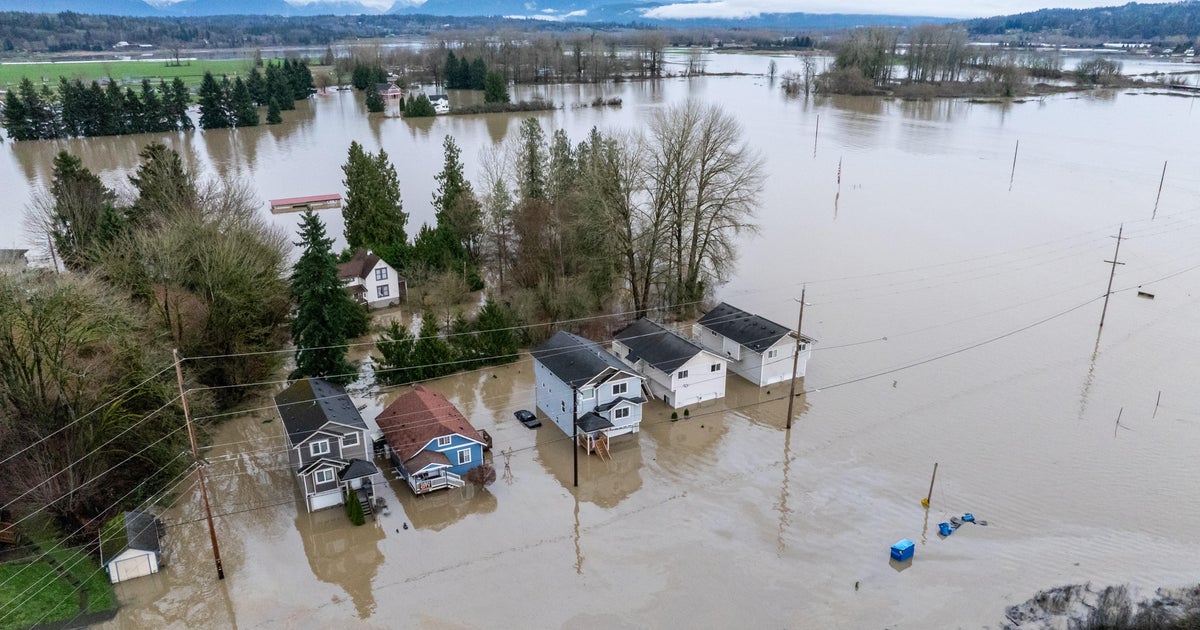
An unusually strong atmospheric river dumped a foot or more of rain across western and central Washington, producing record flooding that forced thousands to evacuate, prompted dozens of water rescues, inundated farmland and livestock (roughly 170 horses, 140 chickens and 90 goats were sheltered), washed out roads and bridges and left communities warned of slow-to-recede waters, potential levee failures and mudslides — a disaster state officials including Gov. Bob Ferguson called costly and time-consuming to recover from. Simultaneously, an arctic air mass is sweeping south from Canada into the Upper Midwest and beyond, delivering wind chills as low as minus-33 F in Grand Forks, ND (actual temps around minus-12 F), with forecasts of about minus-15 F in Minneapolis and near 1 F in Chicago and cold advisories extending as far south as Montgomery, AL and Savannah, GA. Together these events imply near-term disruption to transportation and local economies in the Pacific Northwest, mounting cleanup and infrastructure repair costs, potential insurance losses, and heightened cold-season stresses on energy and utility systems as recovery efforts proceed.
An unusually strong atmospheric river dropped a foot or more of rain across western and central Washington, producing record flooding that forced thousands to evacuate and prompted dozens of water rescues; rivers swelled, roads and bridges were washed out, and floodwaters transformed farmland into lakes. Local officials reported large-scale animal evacuations (about 170 horses, 140 chickens and 90 goats) and prolonged displacement of residents, with a family rescue captured on video illustrating the acute human impact. Washington Gov. Bob Ferguson characterized recovery as expensive, time-consuming and potentially dangerous; officials warn water levels will remain high for days with lingering risks of levee failures and mudslides and additional rain in the forecast. Anecdotal damage estimates include tens of thousands of dollars per household and widespread infrastructure cleanup needs, implying near-term pressure on county services and emergency response budgets. Separately, an arctic air mass is delivering extreme cold to the Upper Midwest (Grand Forks about -12°F with -33°F wind chill, Minneapolis near -15°F, Chicago near 1°F) and cold advisories extending as far south as Montgomery and Savannah. These conditions raise the risk of energy and utility stress, short-term transportation disruptions and amplified economic disruption while Pacific Northwest recovery is underway.
AI-powered research, real-time alerts, and portfolio analytics for institutional investors.
Request DemoOverall Sentiment
moderately negative
Sentiment Score
-0.45
